Table of Contents
Every healthcare organization has something unique about its data environment.
Different EHRs. Different claims feeds. Different contracts. Different provider relationships. Different reporting requirements.
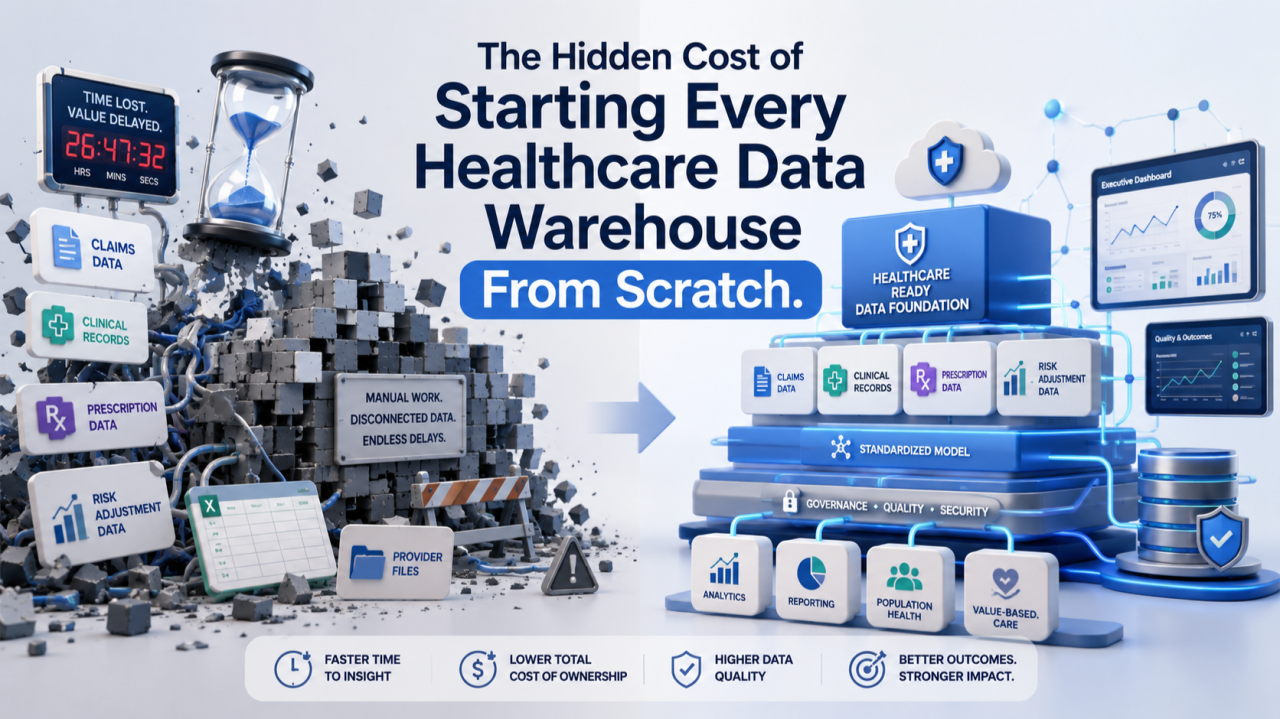
But that does not mean every healthcare data warehouse needs to start with a blank page.
Many warehouse initiatives still begin by rebuilding the same foundational structures: members, eligibility, providers, claims, prescriptions, diagnoses, encounters, and clinical information.
It feels like customization.
In practice, it can create months of work before the organization gets to the problems that are actually unique. And that is where the hidden cost begins.
The Cost is Not Just the Technology
When organizations budget for a healthcare data warehouse, the visible expenses are easy to identify:
- • Cloud infrastructure
- • Engineering resources
- • Integration tools
- • Analytics platforms
- • Consultants or implementation partners
But some of the biggest costs are harder to see.
They show up in the months spent designing schemas, repeated architecture discussions, delayed reporting, engineering rework, and dependence on custom logic that only a few people fully understand.
The warehouse may technically be under construction, but business teams are still waiting.
Risk adjustment still needs better visibility.
Quality teams still need more reliable care gap data.
Operations still needs provider-level insights.
Leadership still needs a trustworthy view of performance.
The longer foundational work takes, the longer those decisions depend on existing spreadsheets, disconnected systems, and manual reporting.
1. Teams Keep Solving the Same Data Problems
Healthcare data is complex. But many of the foundational concepts are not new.
Most healthcare organizations need to represent some version of:
- • Members and patients
- • Eligibility periods
- • Providers and affiliations
- • Medical claims
- • Prescription claims
- • Diagnoses and procedures
- • Clinical encounters
- • Risk adjustment data
When every new warehouse project starts from scratch, architects and engineers spend time deciding how these standard domains should be structured all over again.
- • How should claims be broken into headers and lines?
- • How should eligibility history be stored?
- • How do provider affiliations change over time?
- • How should diagnoses connect to encounters?
These are important questions, but they are also problems the industry has already spent years solving.
Rebuilding all of them does not necessarily make the warehouse better. It often just makes the starting line farther away.
2. Data Modeling Pushes Analytics Further Out
A warehouse becomes valuable when people can actually use the data. That sounds obvious, but it is easy to lose sight of during a large technical implementation.
Before analytics teams can build reliable reporting, the underlying model needs to be established. Source systems then have to be mapped into that model, transformation logic needs to be developed, and outputs have to be validated.
If the model itself takes months to design, everything behind it moves later.
That creates an important difference between two milestones:
The warehouse exists.
and
The organization can use the warehouse to make better decisions.
For healthcare leaders, the second milestone matters far more.
A warehouse delivered quickly on paper but requiring another six months before trusted analytics are available is not really a fast implementation.
3. Customization Can Become Technical Debt
Custom architecture can be valuable when it supports something genuinely specific to the organization.
The problem is customization for its own sake.
A heavily customized healthcare data warehouse requires ongoing knowledge of:
- • Custom schemas
- • Transformation logic
- • Naming conventions
- • Historical business rules
- • Source-specific workarounds
- • Report-specific calculations
As the environment evolves, that complexity grows.
Source systems change. Contracts change. Providers move between organizations. Reporting requirements expand. New acquisitions add new data.
Eventually, maintaining the warehouse may depend on a handful of engineers or consultants who understand why certain decisions were made years earlier.
What started as flexibility becomes technical debt.
The organization is no longer simply maintaining healthcare data. It is maintaining its own unique interpretation of healthcare data architecture.
4. Engineering Talent Gets Used on Foundational Work
Healthcare data engineering expertise is difficult to replace.
Ideally, those teams should be spending their time on problems that create business value:
- • Improving data quality
- • Connecting clinical and claims data
- • Supporting value-based care analytics
- • Identifying rising-risk populations
- • Improving provider performance visibility
- • Preparing trusted data for AI
- • Automating operational workflows
Instead, ground-up implementations can consume a large amount of engineering capacity on foundational modeling.
There will always be some infrastructure work.
But there is an important difference between engineering something because the organization needs a unique solution and engineering something because the project started with an empty database.
The latter carries a significant opportunity cost.
5. Inconsistency Appears Over Time
Starting from scratch also makes it easier for different teams to define the same concepts differently.
One analytics team may calculate membership one way. Another may interpret provider attribution differently. A third may create its own claims logic.
Eventually, multiple versions of the truth appear. Then meetings that should be about performance become meetings about definitions.
A stronger standardized foundation does not eliminate the need for data governance, but it makes governance easier.
Teams have a common structure around which they can establish shared definitions, validation rules, and reporting standards.
That consistency becomes increasingly important as more departments, analytics applications, and AI initiatives depend on the warehouse.
The Biggest Hidden Cost: Delayed Decisions
The largest cost may be the one that never appears in the implementation budget.
Time-to-value.
Suppose a healthcare organization is building a warehouse because leadership needs better visibility into:
- • RAF performance
- • Provider performance
- • Care gaps
- • Utilization
- • Contract performance
- • Population risk
Every additional month spent designing foundational data structures delays those insights.
That delay has an operational cost.
Teams continue using fragmented processes. Opportunities are identified later. Manual reporting continues. Analysts spend time reconciling information instead of analyzing it.
This is why healthcare data warehouse projects should not be evaluated only by development cost.
They should also be evaluated by a simpler question:
How quickly will this architecture help the organization make better decisions?
Not Everything Should Be Standardized
Starting with a pre-built foundation does not mean eliminating customization.
Healthcare organizations absolutely have unique requirements.
- • Their contracts may be different.
- • Their attribution rules may be different.
- • Their workflows may be different.
- • Their reporting requirements may be different.
Those are exactly the areas where custom engineering should be focused.
The goal is not to standardize everything.
It is to avoid spending custom engineering effort on things that do not create differentiation.
A practical principle is:
Standardize what is common. Customize what matters.
A Better Starting Point for Healthcare Data Warehousing
Instead of building every structure from zero, healthcare organizations can begin with models designed around common healthcare domains.
That changes the implementation conversation.
Instead of spending the opening months asking:
How should we represent healthcare data?
Teams can move earlier to:
How does our data map into this structure, and what do we need to adapt for our organization?
That is a much stronger starting point.
The source systems still need to be understood.
The data still needs to be mapped.
Quality still needs to be validated.
Governance still needs to be established.
But the organization is not spending the same amount of time designing foundational healthcare structures before that work can begin.
How Incuvio Warehouse Changes the Starting Point
Incuvio Warehouse was built around this challenge.
It provides standardized healthcare data models covering clinical subject areas, medical claims, prescription claims, and Medicare risk adjustment data. The models are designed for platforms including Microsoft SQL, Snowflake, and AWS Redshift.
Instead of starting with an empty schema, healthcare organizations can begin with an established healthcare data foundation and move into source-to-target mapping earlier.
That can help teams:
- • Reduce repetitive modeling work
- • Accelerate data warehouse implementation
- • Improve consistency across healthcare data domains
- • Move toward analytics readiness sooner
- • Focus engineering resources on organization-specific needs
Incuvio Warehouse does not remove the need for thoughtful architecture.
It changes where that thinking is applied.
Rather than spending the early stages of a project rebuilding common healthcare data structures, teams can focus more attention on the workflows, business rules, contracts, and analytical needs that are actually unique to the organization.
Final Thought
A healthcare data warehouse should be customized where customization creates an advantage.
But starting every project from scratch is not the same thing as building something strategic.
Sometimes it simply means paying again for foundational work that has already been solved.
The better question is:
What part of our data environment genuinely needs to be unique?
Build that.
For the rest, start with a stronger foundation and get to the decisions that matter sooner.