Table of Contents
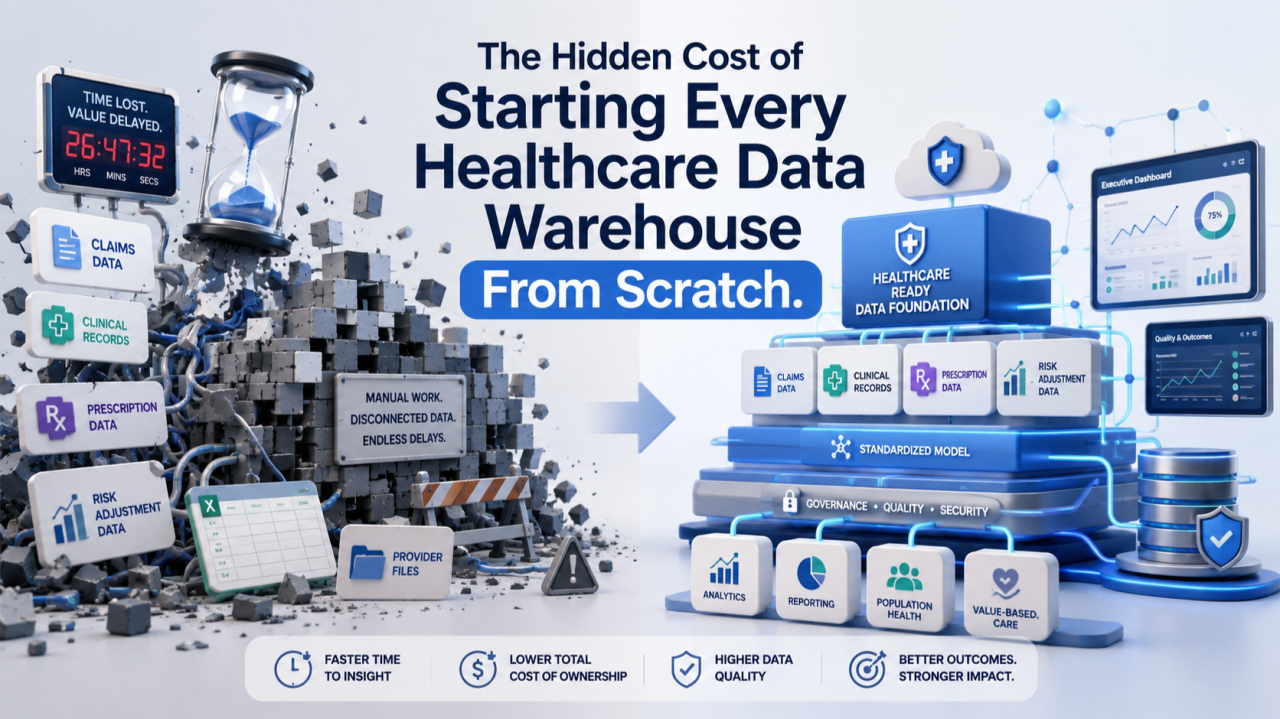
A new healthcare data warehouse project often starts with a familiar promise:
Bring the data together. Create a single source of truth. Give teams better reporting. Make analytics easier.
Then the project begins and months are spent defining schemas, mapping claims, standardizing provider data, resolving member identities, connecting clinical feeds, and debating how the same healthcare concepts should be represented.
Much of this work is important. But not all of it needs to be reinvented every time.
Healthcare organizations often approach each data warehouse as if their underlying data problems are entirely unique. Their business rules, contracts, workflows, and source systems may differ, but the fundamental structures behind claims, eligibility, providers, prescriptions, clinical data, and risk adjustment are common across the industry.
Starting from zero can create costs that extend far beyond the initial technology budget.
The Real Cost Is More Than Infrastructure
When leaders evaluate a healthcare data warehouse initiative, the visible costs are easy to identify:
- • Cloud infrastructure
- • Software licenses
- • Implementation partners
- • Data engineers
- • Analytics tools
- • Integration work
The less visible costs appear later.
Technical teams spend months on foundational modeling before business teams see meaningful results. Analysts continue reconciling spreadsheets while the warehouse is being built. Data engineers spend their time solving problems that have already been solved elsewhere.
Meanwhile, business priorities keep moving.
Risk teams still need better visibility. Quality teams still need actionable care gap information. Finance needs contract performance. Operations needs provider-level reporting.
Every month spent rebuilding foundational structures is another month those teams are waiting.
1. Rebuilding Standard Healthcare Data Structures
Healthcare data is complicated, but many of its core domains are predictable.
Most healthcare organizations need to represent some combination of:
- • Members and patients
- • Eligibility
- • Providers
- • Medical claims
- • Prescription claims
- • Encounters
- • Diagnoses
- • Procedures
- • Clinical information
- • Risk adjustment data
Yet warehouse teams frequently begin by designing these structures again.
How should eligibility periods be represented? How should claim headers relate to claim lines? How should provider affiliations be stored? How should diagnosis history be maintained?
Those are legitimate architecture questions.
The problem is not that teams are answering them.
The problem is that organizations repeatedly spend valuable time answering many of the same questions from scratch.
2. Data Modeling Delays Everything That Comes After It
Before source data can become useful, the destination has to be understood.
If the target healthcare data model is still being designed, source-to-target mapping slows down. Transformation logic remains unsettled. Reporting teams wait for stable structures. Validation gets pushed later into the project.
This creates a chain reaction.
The warehouse may technically exist, but analytics cannot move at the same pace.
That gap between having infrastructure and having usable healthcare data is one of the most underestimated costs of a warehouse implementation.
For leadership, the more useful question is not:
When will the warehouse be deployed?
It is:
When will our teams be able to make better decisions from it?
Those are not necessarily the same date.
3. Custom Architecture Creates a Long-Term Maintenance Burden
A heavily customized warehouse does not stop requiring work when implementation ends.
Source systems change. File formats change. Business rules evolve. New contracts are introduced. Providers move between groups. New analytical requirements appear.
The more custom logic built into the foundation, the more knowledge the organization must preserve internally.
Over time, teams can become dependent on a small number of engineers or consultants who understand why particular tables, mappings, and transformations were created.
When those people leave, maintenance gets harder.
What initially looked like flexibility can eventually become technical debt.
Customization is valuable where the organization is actually different.
It is much less valuable when engineering teams are customizing basic structures that could have been standardized from the beginning.
4. Your Best Technical Talent Gets Pulled Into Plumbing
Healthcare data engineers are valuable because they understand both technology and the complexity of healthcare data.
Ideally, that expertise should be used to solve higher-value problems:
- • Improving data quality
- • Connecting clinical and claims information
- • Building predictive analytics
- • Supporting value-based care
- • Enabling operational workflows
- • Preparing data for responsible AI use
Instead, ground-up warehouse projects can consume large amounts of engineering time on foundational schema design and repetitive mapping.
The opportunity cost matters.
Every hour spent rebuilding common healthcare structures is an hour not spent improving how the organization actually uses its data.
5. Custom Does Not Automatically Mean Better
One of the most common arguments for a ground-up architecture is: “Our organization is different.”
That is usually true.
The question is where it is different.
A health plan’s contracts may be unique. An MSO may have its own attribution logic. A provider group may operate specialized workflows. Business definitions and reporting requirements will vary.
But a medical claim does not need to be reinvented simply because the organization has unique contracts.
A better architecture separates the two.
Standardize what is common. Customize what creates differentiation.
That allows technical teams to spend less effort on foundational healthcare structures and more effort on the areas where the organization’s operating model actually requires something different.
The Compounding Cost of Delayed Analytics
The biggest cost of a slow data warehouse project may never appear as a line item. It is the decisions the organization cannot make while waiting.
Consider an organization trying to improve:
- • RAF visibility
- • Provider performance
- • Care gap closure
- • Utilization management
- • Contract performance
- • Population health operations
The warehouse is not valuable because it contains those datasets. It becomes valuable when teams can use them.
If foundational development repeatedly delays analytics, the organization is paying not only for engineering time but also for delayed operational insight.
That is why time-to-value should be considered alongside implementation cost.
A warehouse that costs slightly less but requires significantly more time before teams can use the data may not actually be the less expensive option.
A Better Approach: Start With the Foundation Already Built
Healthcare organizations do not have to choose between a completely custom warehouse and a rigid one-size-fits-all platform.
There is a middle ground.
A pre-built healthcare data model provides standardized structures for common healthcare domains while leaving room for organization-specific requirements.
Instead of beginning with an empty schema, teams can begin with an established foundation and move into source-to-target mapping earlier.
This changes the starting question from:
“How should we design healthcare data?”
to:
“How does our healthcare data map into this structure, and what is truly unique about our environment?”
That is a much more productive use of implementation time.
What Healthcare Leaders Should Ask Before Starting From Scratch
Before approving another custom healthcare warehouse build, leadership should ask:
- Which parts of our data architecture are genuinely unique?
- Which structures are common across healthcare?
- How much project time will be spent on foundational data modeling?
- When will source-to-target mapping actually begin?
- How soon will business teams receive usable analytics?
- What ongoing maintenance will custom architecture require?
- Could established healthcare data models shorten the path to value?
These questions shift the conversation from technology deployment to business outcome.
How Incuvio Warehouse Changes the Starting Point
Incuvio Warehouse is designed specifically around the time-intensive healthcare data modeling problem.
It provides standardized models covering clinical subject areas, medical and prescription claims, and Medicare risk adjustment data. Incuvio currently supports these models across Microsoft SQL, Snowflake, and AWS Redshift.
The goal is to let healthcare organizations begin data mapping sooner instead of spending the opening phase of every project designing the complete model from scratch. Incuvio describes this approach as a way to reduce the initial modeling bottleneck and accelerate the path toward analytics.
For healthcare organizations, that can mean:
- • Less repetitive modeling work
- • Faster source-to-target mapping
- • Greater consistency across common data domains
- • Less dependence on highly customized foundational architecture
- • More time focused on analytics and business-specific requirements
Incuvio’s broader positioning combines healthcare consulting with proprietary data warehousing capabilities, allowing organizations to connect technology architecture with operational outcomes.
Build What Makes You Different
Healthcare organizations should absolutely customize their data environments where customization creates value.
Their contracts may be different.
Their workflows may be different.
Their operating model may be different.
Their foundational claims, clinical, pharmacy, and eligibility structures do not need to be rebuilt from an empty page every time.
The real question is not whether your healthcare data warehouse should be customized.
It is where your engineering effort is worth customizing.
Start with what healthcare already has in common.
Then invest your time in what actually makes your organization different and what helps your teams make better decisions faster.

You may also like
 Articles
ACCESS Model: What Chronic Care Leaders need to Operationalize
The CMS ACCESS Model has moved from policy concept to operating reality. […]
 Articles
Why Health Plan AI Pilots Fail to Scale
Health plans are investing heavily in AI across predictive analytics, risk adjustment, […]
 Articles
Why Healthcare Data Modeling Takes So Long and How to Fix It
Every healthcare data leader knows the drill. Clinical leadership asks for a […]