Table of Contents
Every healthcare data leader knows the drill.
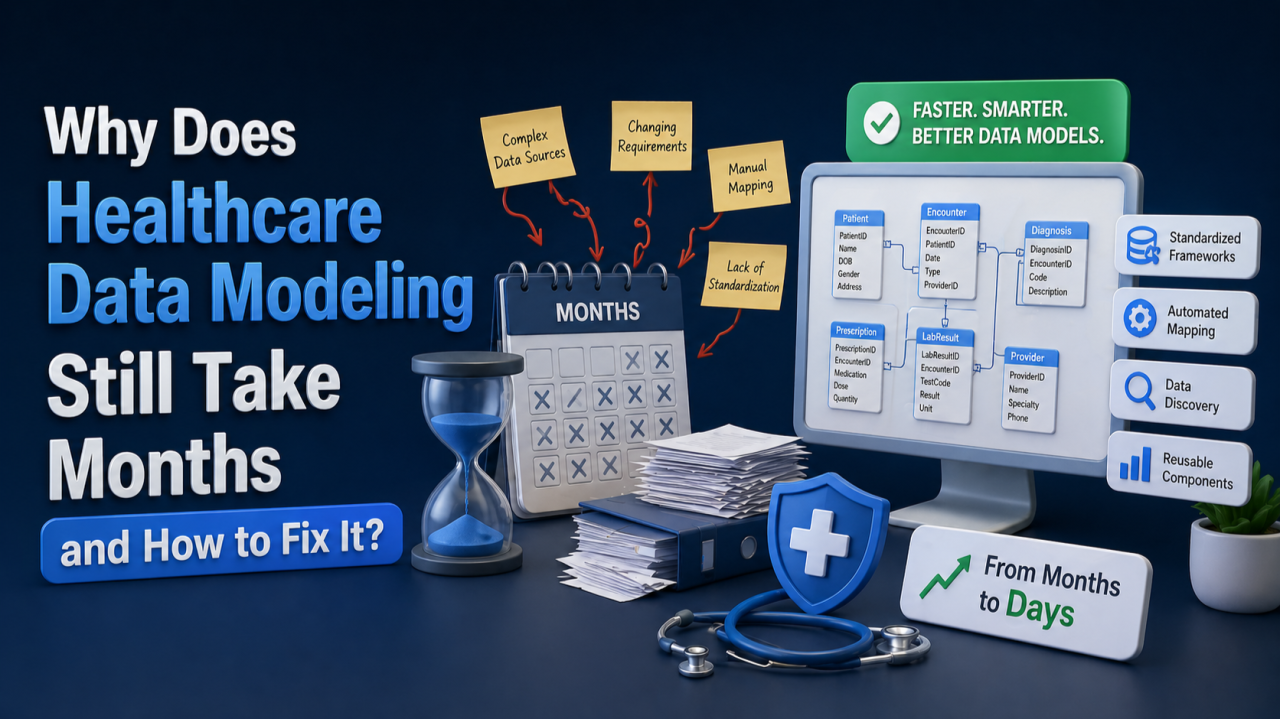
Clinical leadership asks for a predictive model, a population health dashboard, or a new analytics view. In most industries, that might be a sprint. In healthcare, it can easily turn into a months-long project.
By the time the data is ingested, cleaned, standardized, mapped, and modeled, the original business question may have changed or the opportunity to act may already be gone.
So why does healthcare data modeling still take so long?
The Root Cause: Healthcare Data Was Never Built to Work Together
The problem is not a lack of engineering talent. It is the complexity of the data itself.
Healthcare data comes from fundamentally different systems and serves different purposes:
- • Claims data: Structured and consistent, but designed for billing and payment rather than clinical decision-making.
- • Clinical data: Rich in context, but fragmented across HL7 messages, FHIR resources, EHR extracts, and unstructured notes.
- • SDOH data: Critical for understanding the full patient picture, but often scattered across assessments, Z-codes, surveys, and external datasets.
The real bottleneck appears when teams try to bring these sources together.
Standardizing records, resolving duplicates, and mapping local terminology to standards such as SNOMED CT, LOINC, RxNorm, and ICD-10 can consume weeks or months before analytics work even begins.
How Modern Teams Are Cutting Modeling Timelines
Organizations are starting to move away from the idea that every healthcare data project needs to be designed from scratch.
Four approaches are making the biggest difference.
1. Start With Pre-Built Healthcare Data Models
Traditionally, data teams spent significant time designing custom schemas before source mapping could begin.
Today, organizations can start with established models such as OMOP, FHIR-based structures, or purpose-built healthcare warehouse models.
The advantage is simple: teams begin with a known structure and focus their effort on mapping and adapting the data rather than reinventing the foundation.
2. Use AI-Assisted Terminology Mapping
Manual terminology mapping is one of the slowest parts of healthcare data preparation.
Machine learning and LLMs can now help suggest mappings between local codes and standards such as LOINC, SNOMED CT, and RxNorm. NLP can also extract structured clinical and SDOH information from unstructured physician notes.
Human review is still essential, but AI can dramatically reduce the amount of repetitive manual work involved.
3. Move Toward Lakehouse Architecture
Traditional warehouses often require teams to define the final schema before data is loaded.
Modern lakehouse architectures allow organizations to ingest raw clinical and claims data first and then transform it through progressively cleaner layers often referred to as Bronze, Silver, and Gold.
This gives teams more flexibility and reduces the need to finalize every modeling decision upfront.
4. Treat Data Like Software
Healthcare data models should not be treated as static assets.
Data sources change. Business rules evolve. New analytics requirements emerge.
DataOps practices such as automated data-quality testing, monitoring, version control, and iterative development help teams deliver useful models faster and improve them over time.
Instead of waiting months for a “perfect” enterprise model, organizations can deliver a reliable first version and refine it continuously.
The Incuvio Perspective
Healthcare organizations cannot afford to let important analytics and AI initiatives sit behind a six-month modeling cycle.
The faster path is not to simplify healthcare data. It is to stop rebuilding the same foundation every time.
At Incuvio Health, we help healthcare organizations connect claims, clinical, and other critical data sources using modern architecture, standardized models, and more efficient data workflows.
The goal is simple:
Spend less time managing and modeling data and more time using it.
If data bottlenecks are slowing down your analytics or AI initiatives, contact the Incuvio Health team to discuss how to modernize your data infrastructure.

You may also like
 Articles
Why Care Management Programs Struggle to Deliver Better Outcomes
Here’s a pattern we have seen more often than we should. A […]
 Articles
Why Healthcare Organizations Need a Fractional CTO
Healthcare organizations are being asked to make bigger technology decisions faster. Modernize […]
 Articles
The Hidden Cost of Starting Every Healthcare Data Warehouse From Scratch
A new healthcare data warehouse project often starts with a familiar promise: […]