Table of Contents
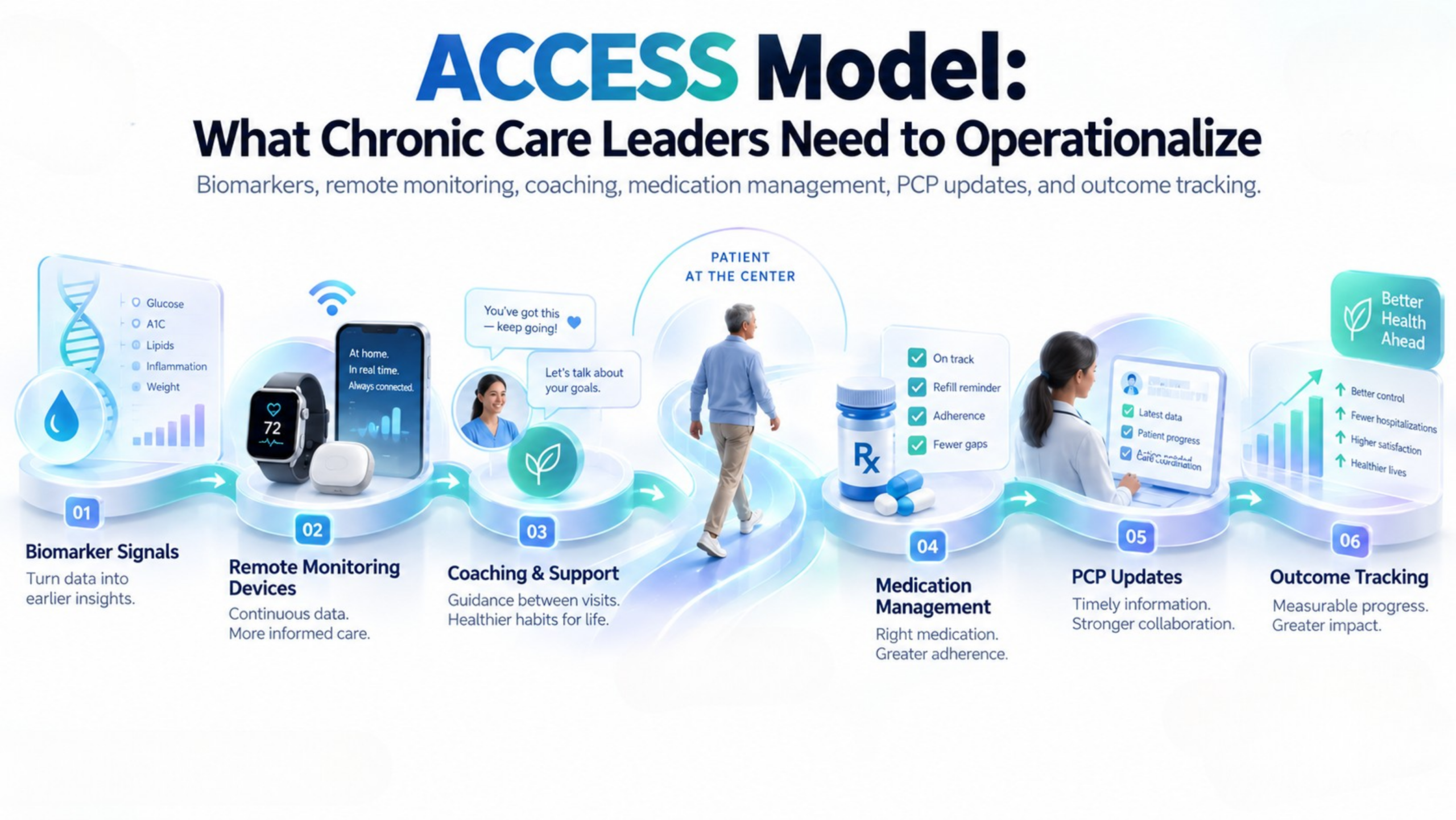
The CMS ACCESS Model has moved from policy concept to operating reality.
The 10-year Advancing Chronic Care with Effective, Scalable Solutions (ACCESS) Model began on July 5, 2026. As of September 15, CMS reported more than 160 participating healthcare organizations, with additional clinical tracks scheduled to begin April 1, 2027.
For chronic care leaders, the bigger question is no longer what ACCESS is.
It is whether the organization has the operational infrastructure to work within an outcomes-based model where eligibility, clinical measures, patient engagement, provider coordination, data exchange, and payment increasingly need to function as one connected system.
ACCESS Changes the Operating Model, Not Just the Payment Model
ACCESS is a voluntary CMS Innovation Center model designed for people with Original Medicare who have qualifying chronic conditions. It introduces Outcome-Aligned Payments (OAPs) for technology-supported chronic care rather than relying entirely on traditional fee-for-service activity.
The initial clinical tracks include:
- • 𝗘𝗮𝗿𝗹𝘆 𝗖𝗮𝗿𝗱𝗶𝗼-𝗞𝗶𝗱𝗻𝗲𝘆-𝗠𝗲𝘁𝗮𝗯𝗼𝗹𝗶𝗰 (𝗲𝗖𝗞𝗠): hypertension and qualifying combinations involving dyslipidemia, overweight or obesity, and prediabetes
- • 𝗖𝗮𝗿𝗱𝗶𝗼-𝗞𝗶𝗱𝗻𝗲𝘆-𝗠𝗲𝘁𝗮𝗯𝗼𝗹𝗶𝗰 (𝗖𝗞𝗠): diabetes, Stage 3a/3b chronic kidney disease, and atherosclerotic cardiovascular disease
- • 𝗕𝗲𝗵𝗮𝘃𝗶𝗼𝗿𝗮𝗹 𝗛𝗲𝗮𝗹𝘁𝗵 (𝗕𝗛): depression and anxiety
- • 𝗠𝘂𝘀𝗰𝘂𝗹𝗼𝘀𝗸𝗲𝗹𝗲𝘁𝗮𝗹 (𝗠𝗦𝗞): chronic musculoskeletal pain
Beginning April 1, 2027, CMS plans to add tracks covering heart failure, chronic obstructive pulmonary disease (COPD), substance use disorder, and tobacco cessation, along with a follow-on option for chronic musculoskeletal care.
This matters because ACCESS is designed around measurable clinical outcomes rather than simply documenting that services occurred.
For organizations accustomed to managing chronic care through disconnected outreach programs, billing workflows, devices, point solutions, and clinical systems, that creates a different operational requirement.
1. Build Operations Around the Clinical Track, Not a Single Condition
One important feature of ACCESS is easy to underestimate: participating organizations are responsible for managing all qualifying conditions within the clinical track in which a beneficiary is enrolled.
That means an organization cannot think only in terms of a diabetes program, blood pressure program, or digital weight-management intervention when operating within a broader CKM framework.
The operating model needs to recognize the member more comprehensively.
For chronic care organizations, this creates several practical requirements:
- • Identify all qualifying conditions reliably
- • Bring claims, clinical, laboratory, pharmacy, and patient-generated information together
- • Maintain track-specific eligibility logic
- • Coordinate interventions across related conditions
- • Avoid creating separate workflows for conditions that CMS expects to be managed together
The clinical track becomes an operating unit.
That has significant implications for data architecture, clinical workflow design, staffing, and measurement.
2. Treat Outcome Measurement as Core Infrastructure
ACCESS ties payment to measurable health outcomes.
Measures vary by clinical track and can include biomarkers such as blood pressure, LDL cholesterol, HbA1c, weight, urinary albumin-to-creatinine ratio (uACR), and estimated glomerular filtration rate (eGFR), as well as validated patient-reported measures for behavioral health and musculoskeletal conditions.
This makes measurement infrastructure much more than a reporting requirement.
Organizations need to know:
- • Which patients require which measures
- • Whether baseline values are available
- • When measurements were collected
- • Where the measurement originated
- • Whether the data meets model requirements
- • Whether patients are progressing toward applicable targets
- • Which patients require intervention before the end of a measurement period
CMS also uses an Outcome Attainment Threshold, allowing organizations to earn full payment when a required proportion of aligned patients meets defined outcome targets.
For leadership teams, that changes the question from:
“Did we deliver the service?” to: “Can we continuously identify where outcomes are trending and intervene before performance is locked in?”
That requires operational analytics, not retrospective reporting.
3. Make Eligibility and Enrollment Part of the Data Workflow
ACCESS beneficiaries voluntarily enroll with participating organizations. Patients may also qualify for multiple ACCESS tracks and can receive those services from the same or different organizations.
That introduces another layer of coordination.
A scalable enrollment workflow should connect:
eligibility → qualifying conditions → track assignment → beneficiary enrollment → care initiation → measurement → ongoing engagement
If eligibility determination happens in one system, enrollment in another, clinical activity in a third, and outcomes reporting somewhere else, teams will spend too much time reconciling the program rather than operating it.
Chronic care leaders should therefore look closely at how member identity, diagnosis information, enrollment status, track participation, clinical measures, and care activity are connected.
ACCESS makes fragmented member data an operational issue.
4. Build Primary Care Coordination Into the Workflow
ACCESS is explicitly designed to complement existing clinical care rather than replace it.
Primary care and referring clinicians can send patients to participating ACCESS organizations, receive structured clinical updates, and receive a Co-Management Payment when they review those updates and perform qualifying care-coordination activities.
Examples can include medication reconciliation, updates to the problem list, monitoring instructions, coordination with other clinicians, or documented clinical responses to ACCESS recommendations.
CMS currently allows the Co-Management Payment up to three times within 12 months per beneficiary per ACCESS track. Operationally, this means communication with the existing care team cannot remain an afterthought.
Organizations need workflows for:
- • Identifying the appropriate clinician
- • Delivering the required clinical update
- • Confirming that the information reached the clinician
- • Supporting review within the clinician’s existing workflow
- • Capturing subsequent clinical action
- • Maintaining an auditable record of the exchange
Simply generating another PDF, portal notification, or disconnected message is unlikely to create reliable co-management at scale. The information needs to reach the point where clinical decisions are being made. This is ultimately a clinical workflow technology challenge: information has to move from data capture to the right clinician, at the right point in the workflow, with a clear action attached.
5. Understand the Fee-for-Service Boundary Before Scaling
ACCESS also introduces payment rules that require careful operational planning.
For beneficiaries actively aligned to an ACCESS participant, the participant and certain affiliated entities cannot simultaneously submit traditional Medicare fee-for-service claims for other services furnished to that same beneficiary during the active care period. ACCESS G-codes are used under the model instead.
That makes billing architecture, organizational relationships, contracting, and patient attribution important implementation issues.
Organizations should understand exactly where ACCESS participation intersects with:
- • Existing Medicare billing
- • Affiliated entities
- • Contracted care-management arrangements
- • ACO relationships
- • Existing chronic care programs
- • Clinical service lines
These decisions should be mapped before enrollment grows. Otherwise, what initially looks like a payment configuration issue can quickly become a compliance and reconciliation problem.
6. ACOs and Risk-Bearing Organizations Need Their Own ACCESS Strategy
ACCESS also matters to organizations that are not themselves ACCESS participants.
ACOs and other risk-bearing entities can refer aligned beneficiaries to ACCESS organizations and use these services as another chronic care option.
CMS currently anticipates no impact from ACCESS Outcome-Aligned Payments on Medicare Shared Savings Program and ACO REACH benchmark and performance-year calculations for 2026 and 2027. Beginning in 2028, ACCESS expenditures are expected to be incorporated into those calculations.
That creates an important strategic question for ACO leadership:
Where should ACCESS sit within the organization’s broader chronic care and population health model?
The answer requires more than finding participating vendors.
Organizations need visibility into which members are participating, which tracks they are enrolled in, what outcomes are being generated, how information returns to the primary care team, and how ACCESS fits alongside existing care-management programs.
Without that visibility, ACCESS risks becoming another external program operating alongside the care model rather than within it.
7. Create a Connected Data Layer Across ACCESS Operations
ACCESS is fundamentally dependent on data moving across organizational boundaries.
A workable operating model may need to connect:
- • Medicare eligibility information
- • Claims and diagnosis data
- • EHR information
- • Laboratory results
- • Medication information
- • Patient-reported outcomes
- • Remote or technology-generated data
- • Enrollment status
- • Care-management activity
- • Provider information
- • Clinical updates
- • Outcome measures
- • Payment and performance data
The challenge is not simply ingesting these sources.
The organization needs a shared view of the beneficiary, the clinical track, required measures, interventions, responsible care teams, and performance status. That is where the underlying healthcare data model becomes particularly important.
Without consistent member identity, clinical definitions, provider relationships, and measure logic, ACCESS reporting may become another reconciliation exercise.
8. Governance Has to Scale With Technology-Supported Care
Technology does not reduce the need for clinical governance.
CMS requires participating ACCESS organizations to enroll in Medicare Part B as providers or suppliers, comply with applicable licensure requirements, meet relevant privacy and security obligations, address applicable FDA requirements, and designate physician leadership responsible for clinical oversight and compliance. CMS also intends to publicly report risk-adjusted outcomes.
For healthcare executives, that means ACCESS governance should span more than the clinical team. A strong operating structure should bring together clinical leadership, compliance, technology, data, operations, finance, security, and product teams.
Accountability for outcomes needs to be equally clear.
ACCESS Readiness Is Really Operational Readiness
The organizations best positioned for ACCESS will not necessarily be the ones with the most digital tools. They will be the organizations that can connect the entire operating cycle:
Identify the right beneficiary → enroll them correctly → coordinate care → capture reliable clinical data → measure outcomes → communicate with the existing care team → intervene when performance is off track → report and reconcile payment.
That requires clinical capability, but it also requires an integrated data and technology foundation. Organizations approaching this as part of a broader healthcare digital transformation roadmap can also avoid building infrastructure that only works for a single CMS model or clinical program.
As ACCESS expands into additional chronic conditions in 2027, the complexity of operating disconnected programs will only increase.
The strategic opportunity is to build the infrastructure once and make it capable of supporting multiple conditions, tracks, care partners, measurement frameworks, and payment arrangements.
How Incuvio Can Help
Operationalizing models like ACCESS requires healthcare organizations to connect strategy with the underlying data, technology, and workflows needed to execute it.
Incuvio Health works with healthcare organizations on healthcare data management, technology strategy, enterprise architecture, and operational modernization.
For organizations preparing for increasingly outcomes-oriented chronic care models, that can include evaluating the current data environment, identifying interoperability and workflow gaps, developing a scalable healthcare data architecture, and creating a practical technology roadmap for execution.
The goal should not be another ACCESS-specific silo.
It should be a healthcare data and operating foundation capable of supporting ACCESS and the broader shift toward measurable, outcomes-based care.

You may also like
 Articles
Why Health Plan AI Pilots Fail to Scale
Health plans are investing heavily in AI across predictive analytics, risk adjustment, […]
 Articles
Why Healthcare Data Modeling Takes So Long and How to Fix It
Every healthcare data leader knows the drill. Clinical leadership asks for a […]
 Articles
Why Care Management Programs Struggle to Deliver Better Outcomes
Here’s a pattern we have seen more often than we should. A […]