Table of Contents
Healthcare organizations rarely lack data. They have claims, encounters, eligibility files, EHR records, pharmacy activity, laboratory results, provider directories, quality measures, care management notes, and financial reports.
The real challenge is making all that information work together.
The same member may appear under different identifiers across several systems. Provider affiliations may change. A diagnosis may appear in a claim but not in the clinical record available to the care team. A care gap may look closed in one platform and remain open in another.
A healthcare data model brings structure to this complexity.
It defines how members, providers, encounters, diagnoses, quality measures, contracts, and operational activities relate to one another. When designed well, it gives teams a reliable foundation for reporting, analytics, workflows, and decision-making.
What is a Healthcare Data Model?
A healthcare data model is an organized representation of the people, events, clinical information, financial activity, and operational processes within a healthcare organization.
It defines:
- • What information should be stored
- • How different data elements are connected
- • How records from separate systems are matched
- • How historical changes are preserved
- • How data quality and lineage are tracked
- • How information becomes usable for analytics and operations
A strong data model creates a shared language across technical, clinical, operational, and financial teams.
It is not simply a database design. It reflects how the organization understands its members, providers, performance, and responsibilities.
Why Healthcare Data Modeling Is Difficult
Healthcare data is complex because healthcare itself is complex.
A member may interact with multiple providers, facilities, pharmacies, laboratories, and care management programs. Coverage may change. Attribution may change. Claims can arrive weeks after care is delivered, while clinical data may arrive through a different system.
Different sources also tell different parts of the story.
Claims are useful for understanding billed services, diagnoses, utilization, and costs. Clinical records provide more detailed context. Eligibility files define covered periods. Attribution files identify which provider or group is accountable for a member.
A good healthcare data model connects these sources without treating them as interchangeable.
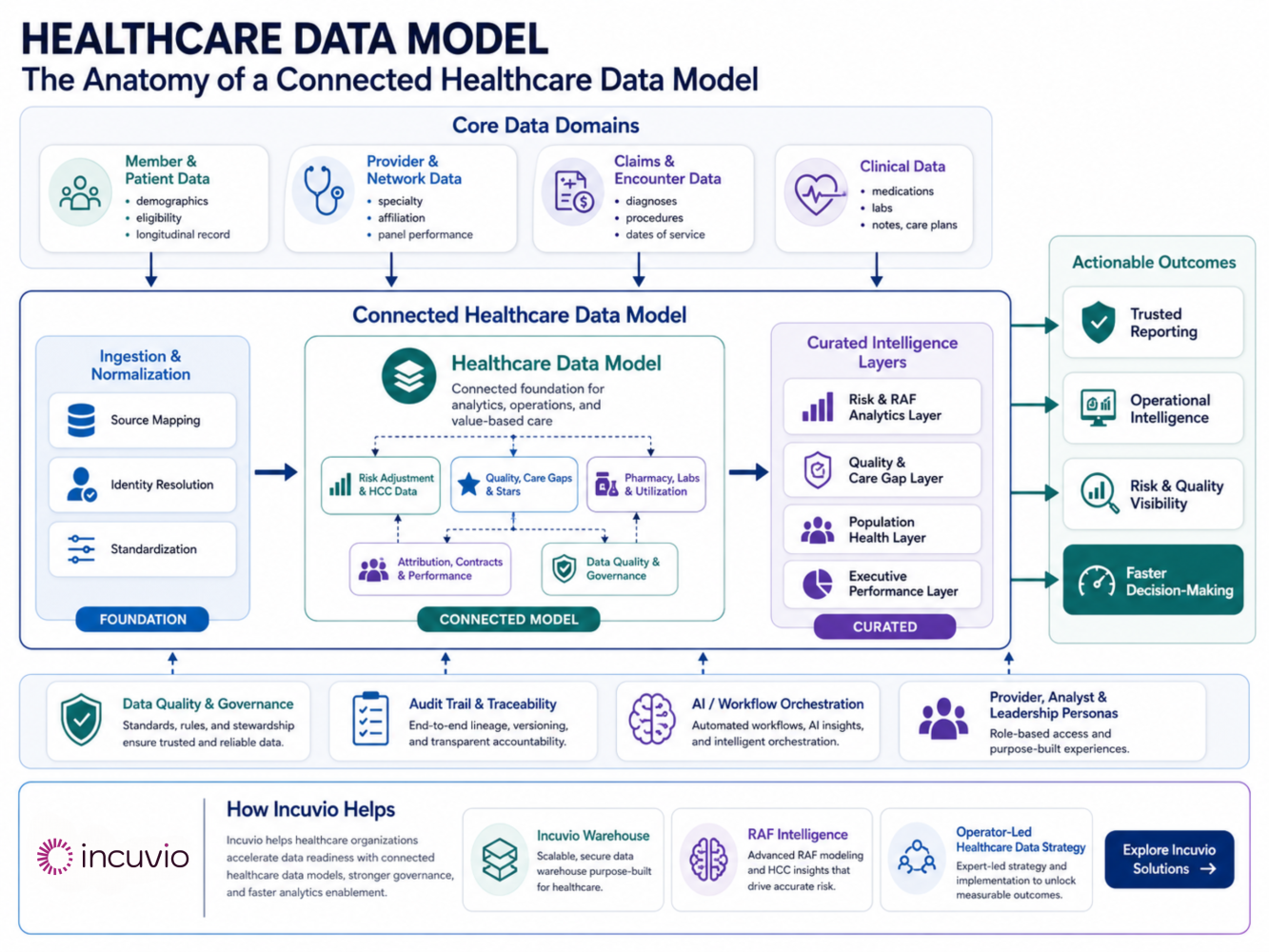
The Core Components of a Healthcare Data Model
1. Member and Patient Identity
The member or patient is at the center of most healthcare analysis. This part of the model should connect demographic information, identifiers, contact details, coverage history, attribution, clinical activity, and program participation.
The most important challenge is identity resolution.
The same person may appear under different identifiers across claims systems, EHRs, laboratory feeds, pharmacy files, and care management platforms. A strong model creates a reliable longitudinal record without losing the original source information.
Without accurate member identity, downstream reporting becomes difficult to trust.
2. Eligibility and Attribution
Eligibility determines when an individual belongs to a covered population.
The model should preserve:
- • Coverage start and end dates
- • Plan and product information
- • Line of business
- • Contract participation
- • Enrollment changes
Attribution identifies which provider, group, or organization is accountable for the member during a specific period.
These relationships should be historically dated. Replacing an old attribution with the latest one can distort quality, utilization, RAF, and contract performance reporting.
3. Provider and Network Data
Provider data is more than a directory. A healthcare data model should distinguish between individual clinicians, practices, facilities, medical groups, networks, and contractual entities.
It should connect providers to:
- • Members
- • Encounters
- • Claims
- • Practices and facilities
- • Network affiliations
- • Contracts
- • Quality performance
- • Documentation opportunities
Because provider relationships change, effective dates and historical affiliations are essential.
4. Claims and Encounter Data
Claims and encounter data show what was billed, submitted, processed, and paid. This layer often includes diagnoses, procedures, dates of service, place of service, provider information, claim amounts, and submission status.
A strong model should also account for corrected, voided, replaced, or reprocessed claims.
It should distinguish between the clinical encounter and the administrative claim. One visit may create several claim lines, and a corrected claim should not be counted as a second encounter.
5. Clinical and EHR Data
Clinical data adds context that claims alone cannot provide.
This may include:
- • Diagnoses and problem lists
- • Medications
- • Allergies
- • Vital signs
- • Laboratory results
- • Procedures
- • Care plans
- • Progress notes
- • Clinical observations
A strong model should distinguish between a diagnosis documented during a visit, a diagnosis on a problem list, and a suspected condition generated by an analytical model.
Those concepts may be related, but they are not the same. The model should also preserve when the information was recorded, who documented it, and where it came from.
6. Pharmacy, Laboratory, and Utilization Data
Pharmacy and laboratory data provide valuable signals that may not be visible in claims or EHR extracts alone.
Pharmacy data can support medication adherence, therapy gap, and chronic condition analysis. Laboratory data can provide evidence for disease monitoring and quality measures.
Utilization data can identify:
- • Emergency department visits
- • Inpatient admissions
- • Readmissions
- • Skilled nursing stays
- • High-cost services
- • Changes in care patterns
When these sources are connected, organizations can identify rising risk and care needs earlier.
7. Risk Adjustment and Documentation
Risk adjustment requires a structured connection between diagnoses, documentation, coding, submissions, and supporting evidence.
This layer may include:
- • HCC mappings
- • Previously documented conditions
- • Current-year captures
- • Suspected conditions
- • Recapture opportunities
- • Coding reviews
- • Submission status
- • Supporting documentation
A mature model should clearly separate a suspected condition from a validated diagnosis. It should also show where the information came from, whether it was reviewed, and whether supporting evidence is available.
This traceability helps risk adjustment teams move beyond a final RAF score and understand what is driving performance.
8. Quality Measures and Care Gaps
Quality data modeling involves more than storing an open or closed care gap.
The model should explain:
- • Which measure applies
- • Which members are eligible
- • What created the gap
- • What evidence can close it
- • Which provider or team owns the action
- • What outreach has already occurred
- • Whether closure has been confirmed
The strongest models connect quality measurement to workflow. Instead of simply showing open gaps, they help teams understand what needs to happen next.
9. Contracts and Financial Performance
Value-based care requires clinical and operational data to be connected to financial accountability.
This part of the model may include:
- • Contract definitions
- • Covered populations
- • Performance periods
- • Quality requirements
- • Financial benchmarks
- • Risk arrangements
- • Shared-savings calculations
- • Provider incentives
A connected model helps leaders understand not only whether a contract is underperforming, but also what is driving the result.
10. Workflow and Operational Activity
One of the most overlooked parts of a healthcare data model is the work being performed by people.
An operational layer should track:
- • Tasks
- • Assignments
- • Work queues
- • Outreach attempts
- • Provider notifications
- • Reviews
- • Escalations
- • Status changes
- • Completion outcomes
This turns a reporting model into an operating model.
A dashboard may show that thousands of care gaps are open. The workflow layer shows which gaps have been assigned, which members were contacted, what remains unresolved, and which interventions are producing results.
Data Quality, Governance, and Lineage
A healthcare data model is useful only when people trust it.
The organization should be able to answer:
- • Where did this value come from?
- • When was the record received?
- • Which transformation or rule was applied?
- • Which source takes priority when records conflict?
- • Who owns the business definition?
- • How often is the information refreshed?
- • Can the result be traced back to its origin?
Strong governance includes source lineage, common business definitions, effective dating, quality rules, version history, validation results, and audit trails.
Governance should be built into the model rather than added after reports begin producing conflicting numbers.
How the Components Work Together
The value of a healthcare data model comes from connection. Consider a member who recently visited the emergency department.
The claims layer records the service. The clinical layer may provide diagnoses and discharge information. Eligibility confirms that the member was covered. Attribution identifies the accountable provider.
The utilization layer recognizes a change in care pattern. The risk layer may identify a condition requiring review. The quality layer may show a follow-up opportunity. The workflow layer assigns the action and tracks whether it was completed.
Leadership can then see not only that utilization increased, but also who was affected, which provider is accountable, what action is needed, and whether the organization responded.
That is what a connected healthcare data model should enable.
Where Healthcare Data Models Commonly Fail
Many healthcare data projects struggle because the model was built around immediate reporting needs rather than long-term use.
Common issues include:
- • Building the model for one dashboard
- • Overwriting historical eligibility or attribution
- • Combining suspected and confirmed conditions
- • Treating claims and clinical encounters as the same event
- • Designing without clinical or operational input
- • Using separate definitions across departments
- • Ignoring workflow and intervention data
- • Treating governance as a data dictionary exercise
These choices may make an initial report easier to build, but they create problems as the organization adds new use cases.
What a Strong Healthcare Data Model Should Enable
A well-designed model should help teams answer important questions quickly:
- • Which members are rising risk?
- • Which care gaps remain open?
- • Which providers need support?
- • Which diagnoses have current documentation?
- • Which contracts are moving off target?
- • Which submissions are delayed or rejected?
- • Which interventions are improving performance?
- • Which data sources are incomplete or outdated?
The goal is not only to store information more efficiently. The goal is to reduce the distance between identifying a signal and taking action.
A Practical Healthcare Data Model Checklist
Healthcare leaders should ask:
- • Do we have a reliable longitudinal member identity?
- • Are eligibility, attribution, and provider affiliations historically dated?
- • Are claims, encounters, and clinical events represented separately?
- • Can important results be traced back to their source?
- • Are clinical, quality, risk, utilization, and financial data connected?
- • Does the model include workflow and intervention activity?
- • Are definitions consistent across departments?
- • Can calculated results be reproduced and explained?
- • Can the model support new use cases without major redesign?
- • Is the foundation ready for advanced analytics and AI?
Several “no” answers may indicate that the organization has built a reporting repository rather than a durable healthcare data foundation.
Build Around Decisions, Not Just Data Sources
A common approach is to create a separate structure for every incoming source file. That may simplify data ingestion, but it does not always create an effective enterprise model.
A stronger approach begins with the decisions and workflows the organization needs to support.
These may include:
- • Improving provider performance
- • Managing risk contracts
- • Identifying rising-risk members
- • Closing care gaps
- • Strengthening clinical documentation
- • Monitoring encounter submissions
- • Coordinating care transitions
- • Measuring outreach effectiveness
The source systems can then be mapped into a shared structure that supports those outcomes.
How Incuvio Helps Accelerate Healthcare Data Modeling
Healthcare organizations often spend a significant part of a data warehouse implementation designing schemas, relationships, and common healthcare definitions before analytics work can begin.
Incuvio Warehouse provides pre-built healthcare data models for key clinical, claims, pharmacy, and Medicare risk adjustment domains.
This gives organizations a practical starting point rather than requiring every implementation to begin with a blank database.
Incuvio Warehouse helps teams:
- • Begin source-to-target mapping earlier
- • Standardize common healthcare data domains
- • Reduce repetitive modeling work
- • Accelerate analytics readiness
- • Improve consistency across reports
- • Strengthen governance and traceability
- • Support future operational and analytical use cases
Pre-built does not mean one-size-fits-all.
The model still needs to reflect the organization’s source systems, workflows, contracts, and reporting needs. The advantage is that teams can start with a healthcare-aware foundation and focus more effort on the areas that are truly unique.
Final Thought
A healthcare data model is not valuable simply because its tables are organized. It is valuable because it helps the organization understand what is happening, agree on what the information means, and take the right action with confidence.
The strongest models connect members, providers, claims, clinical activity, quality, risk, contracts, and operational work while preserving the important differences between them.
In healthcare, the data model is not just where information is stored. It is the foundation for how the organization understands its population and improves performance.

You may also like
 Articles
ACCESS Model: What Chronic Care Leaders need to Operationalize
The CMS ACCESS Model has moved from policy concept to operating reality. […]
 Articles
Why Health Plan AI Pilots Fail to Scale
Health plans are investing heavily in AI across predictive analytics, risk adjustment, […]
 Articles
Why Healthcare Data Modeling Takes So Long and How to Fix It
Every healthcare data leader knows the drill. Clinical leadership asks for a […]