Table of Contents
RADV readiness is often treated as an audit-response project.
A Medicare Advantage organization receives a request, compliance teams assemble a working group, providers are contacted, records are retrieved, and coding teams begin validating years-old diagnoses.
That approach may eventually produce the requested files, but it creates unnecessary pressure.
True RADV readiness means the evidence behind a diagnosis can be found, understood, and defended before an audit notice arrives.
CMS uses Medicare Advantage Risk Adjustment Data Validation audits to confirm that diagnoses submitted for risk-adjusted payment are supported by enrollee medical records. When diagnoses are not supported, CMS may recover overpayments. CMS has also expanded its audit strategy to include all eligible MA contracts in newly initiated payment-year audits, making continuous readiness more important for plans of every size.
The central question is no longer simply: Do we have the medical record?
It is: Can we connect the submitted diagnosis to a valid medical record, the correct member, the appropriate encounter, the coding decision, and the final submission?
That complete evidence trail is the foundation of RADV readiness.
RADV Readiness is a Data Traceability Problem
Most Medicare Advantage organizations have large volumes of clinical and risk adjustment data.
The problem is that the information may be spread across:
- • EHR systems
- • Claims and encounter platforms
- • Coding applications
- • Chart review vendors
- • Provider portals
- • Document repositories
- • Submission files
- • Internal spreadsheets
- • Risk adjustment dashboards
A diagnosis may appear in a RAF report while the supporting note lives in an EHR archive. The coding decision may be stored with a vendor, and the submission history may sit in a separate operational system.
Each component may exist, but the full story is difficult to reconstruct.
RADV readiness requires the organization to preserve the relationship between the diagnosis submitted for payment and the documentation used to support it.
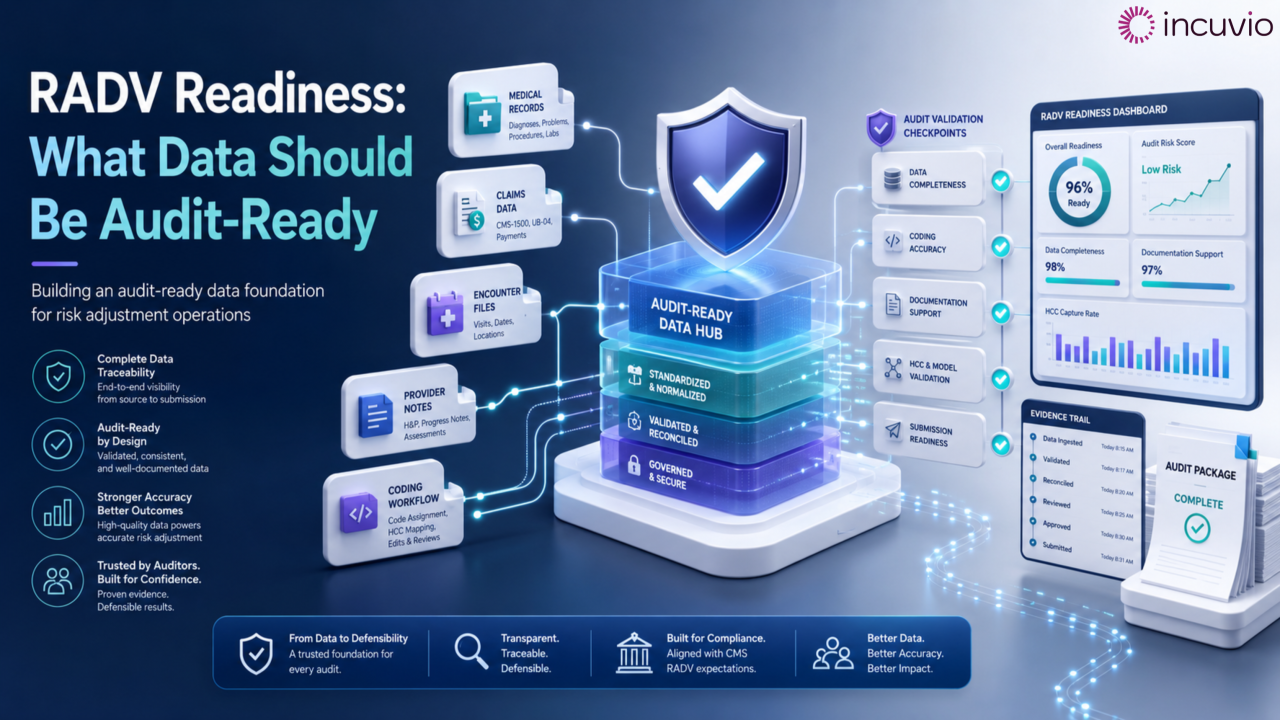
What Data Should be Audit-Ready?
Audit readiness involves more than storing medical records. Plans need connected and searchable information across the full risk adjustment lifecycle.
1. Member and Diagnosis History
The organization should maintain a longitudinal view of each member’s risk adjustment activity.
This should include:
- • Member identifiers
- • Eligibility and contract information
- • Dates of service
- • Submitted diagnosis codes
- • HCC mappings
- • Source encounters
- • Provider information
- • Submission status
- • Correction or deletion history
- • Supporting medical records
This history helps teams understand not only which diagnosis was submitted, but where it came from and what happened after submission.
Historical values should not be overwritten whenever new data arrives. If a diagnosis was corrected, deleted, resubmitted, or mapped differently, the organization should be able to see the sequence of events.
2. Supporting Medical Record Evidence
The medical record is at the center of a RADV review.
CMS audit instructions require Medicare Advantage organizations to submit valid medical record documentation supporting audited HCCs. Current instructions describe requirements such as matching the record to the correct enrollee, connecting it to the relevant date of service, and ensuring the submitted documentation meets applicable validity requirements.
For operational readiness, each supporting record should be connected to:
- • The correct member
- • The relevant encounter
- • The date of service
- • The rendering or documenting provider
- • The submitted diagnosis
- • The corresponding HCC
- • The source system
- • The payment year
- • The validation status
The record should also be readable, complete, properly dated, and associated with appropriate provider information.
Simply storing a PDF in a document repository is not enough if teams cannot determine which diagnosis it supports.
3. Claims and Encounter Data
Claims and encounter data provide the administrative history behind the diagnosis.
Plans should be able to identify:
- • Where the diagnosis originated
- • When the encounter occurred
- • Which provider delivered the service
- • Which care setting was involved
- • Whether the encounter was accepted
- • Whether the record was later corrected
- • How the diagnosis entered the risk adjustment process
CMS provides audited plans with enrollee and HCC information tied to diagnosis codes submitted through applicable risk adjustment or encounter data systems. Plans are then responsible for producing medical records supporting the selected HCCs.
Connecting encounter data with the supporting record reduces the need to reconstruct this information manually during an audit.
4. Coding and Chart Review Decisions
Many risk adjustment programs rely on internal coders, external vendors, chart review teams, or analytical tools to identify potential diagnoses. Those workflows should leave a clear decision trail.
Audit-ready coding data should show:
- • Who reviewed the record
- • When the review occurred
- • Which diagnosis was identified
- • What documentation supported it
- • Which coding guidance was applied
- • Whether the diagnosis was accepted or rejected
- • Whether additional review was required
- • Whether it was ultimately submitted
A final diagnosis code without this history provides limited insight into how the decision was made.
Vendor-generated codes should not become a black box. The Medicare Advantage organization should retain access to the underlying evidence, review results, and decision history even when an outside partner performed the work.
5. Provider and Documentation Information
A diagnosis cannot be evaluated separately from the provider and documentation context.
Plans should preserve:
- • Provider identity
- • Credentials and specialty
- • Practice or facility
- • Encounter type
- • Signature information
- • Date of service
- • Documentation source
- • Provider affiliation at the time of service
Provider data should also be historically accurate. Practices close, physicians retire, vendors change, and EHR systems are replaced. Waiting several years to determine where an old medical record is stored can create a significant retrieval challenge.
Current CMS instructions also reference long-term record-retention responsibilities and the need to pursue alternative medical record sources when the initial record is unavailable or insufficient.
A practical readiness program should therefore include provider-level record location and retrieval information, not only diagnosis performance metrics.
6. Submission, Correction, and Deletion History
Plans need a reliable record of what was sent to CMS and when.
The data trail should include:
- • Original submission
- • Submission date
- • Source encounter
- • Diagnosis code
- • HCC mapping
- • Acceptance or rejection status
- • Corrections
- • Deletions
- • Resubmissions
- • Final status
This matters because the current state of a dashboard may not reflect the full submission history.
A diagnosis may have been submitted and later deleted. An encounter may have been corrected. A code may appear in an internal platform but never reach the final payment calculation.
Plans should preserve the complete sequence rather than displaying only the latest status.
When an audit begins, teams should also follow the instructions issued for that specific payment year. For example, current audit methods may contain particular directions concerning corrections or overpayment reporting for enrollees included in the audit sampling frame.
7. Internal Validation Results
Organizations should not wait for CMS to identify unsupported diagnoses.
Internal validation may include:
- • Coding accuracy reviews
- • Medical record validity checks
- • Unsupported diagnosis reviews
- • Provider documentation audits
- • Vendor quality assessments
- • Targeted HCC sampling
- • Submission reconciliation
- • Overpayment identification workflows
These reviews should be documented.
Teams need to know what was tested, how the sample was selected, which issues were found, who approved the results, and what corrective action followed.
Internal audits are most valuable when they improve future operations. Recurring documentation problems should lead to better provider support. Frequent coding disagreements should lead to clearer review standards. Missing records should lead to improved retrieval and retention processes.
What Does Audit-Ready Data Look Like?
Audit-ready data should be more than available.
It should be:
Connected: The diagnosis, member, encounter, provider, medical record, coding decision, and submission are linked.
Traceable: Teams can identify the original source and every important change made afterward.
Retrievable: Evidence can be located without weeks of manual searching.
Validated: Medical records and coding decisions have passed defined quality checks.
Versioned: Corrections, deletions, and historical mappings are preserved.
Governed: Ownership, definitions, retention rules, and review responsibilities are clear.
Defensible: The organization can explain why a diagnosis was submitted and show the evidence supporting that decision.
A large document archive may contain thousands of medical records and still fail these tests.
Common RADV Readiness Gaps
Several problems repeatedly make audit preparation more difficult.
1. Fragmented Evidence
The medical record, encounter, coding result, and submission history are stored in separate systems with no common identifier tying them together.
2. Missing Decision History
The organization knows that a diagnosis was submitted but cannot determine who reviewed it or what evidence supported the decision.
3. Vendor Dependence
Important chart review and coding records remain with a former vendor and are difficult to retrieve after the contract ends.
4. Overwritten Data
The current diagnosis or HCC status replaces previous values, making it impossible to reconstruct historical submissions.
5. Weak Record Retrieval
Plans know which provider documented a diagnosis but do not know where the medical record is currently maintained.
6. Audit Readiness Limited to Compliance
Compliance owns the audit response, but data, coding, provider engagement, IT, and vendor management teams do not share responsibility for evidence readiness.
These are not only compliance problems. They are data architecture and operating model problems.
A Practical RADV Readiness Checklist
Medicare Advantage leaders should be able to answer the following questions:
- • Can every submitted diagnosis be linked to its supporting medical record?
- • Can we connect that record to the correct member, provider, encounter, and date of service?
- • Do we preserve submission, correction, and deletion history?
- • Can we explain how chart review and coding decisions were made?
- • Can we retrieve older records when providers or vendors have changed?
- • Are medical records checked for validity before submission?
- • Do internal reviews identify unsupported diagnoses early?
- • Can compliance, coding, data, and operations work from the same evidence trail?
- • Are data ownership and retention responsibilities clearly defined?
- • Could we assemble the required documentation without creating a last-minute manual project?
Several “no” answers usually indicate that RADV readiness is still reactive.
From Audit Preparation to Continuous Readiness
RADV readiness should not begin when an audit notice is received. It should be part of everyday risk adjustment operations.
That means validating documentation before submission, tracking the origin of diagnosis data, preserving coding decisions, monitoring record quality, and maintaining access to supporting evidence over time.
CMS now maintains payment-year-specific audit instructions, FAQs, schedules, audited contract lists, and other RADV materials that plans should review as part of their readiness process.
The exact audit process may vary by payment year. The underlying operational principle does not:
The organization should be able to move from a submitted diagnosis to defensible evidence without reconstructing the entire process manually.
How Incuvio Supports Stronger RADV Readiness
RADV readiness depends on a connected healthcare data foundation.
Incuvio helps healthcare organizations bring together risk adjustment, clinical, claims, encounter, provider, and operational information so teams can improve traceability and reduce dependence on disconnected reports.
Incuvio RAF Intelligence supports visibility into RAF opportunities, risk trends, analytics, and actionable reporting. Incuvio Warehouse provides a healthcare-focused data foundation that can help organizations standardize important data domains and improve access to trusted information.
Together, a stronger data foundation and RAF intelligence layer can help teams:
- • Connect diagnoses to supporting evidence
- • Track risk adjustment activity over time
- • Improve coding and documentation visibility
- • Reduce manual data reconciliation
- • Identify potential documentation gaps earlier
- • Support more consistent internal validation
- • Retrieve audit-related information faster
The objective is not simply to respond to an audit more efficiently. It is to make evidence readiness part of the organization’s normal operating model.
Final Thought
RADV readiness is not determined by how quickly a team can assemble files after receiving an audit request.
It is determined by whether the organization has maintained a clear, connected, and defensible evidence trail from the beginning.
The medical record matters.
But so do the member history, source encounter, provider information, coding decision, submission record, validation process, and governance behind it.
When those elements are connected, audit readiness becomes less of a crisis response and more of a disciplined data practice.

You may also like
 Articles
ACCESS Model: What Chronic Care Leaders need to Operationalize
The CMS ACCESS Model has moved from policy concept to operating reality. […]
 Articles
Why Health Plan AI Pilots Fail to Scale
Health plans are investing heavily in AI across predictive analytics, risk adjustment, […]
 Articles
Why Healthcare Data Modeling Takes So Long and How to Fix It
Every healthcare data leader knows the drill. Clinical leadership asks for a […]