Table of Contents
For Medicare Advantage plans, RAF performance is no longer just a coding exercise.cIt is an operating discipline.
A plan may have strong reports, experienced coders, provider education materials, and retrospective chart review support. But if the full risk adjustment process is fragmented across data teams, coding teams, provider engagement, compliance, vendors, and finance, RAF performance becomes harder to manage with confidence.
The question is not only, “Are we finding HCC opportunities?”
The better question is, “Do we have the operating model to identify, validate, document, submit, and defend those opportunities consistently?”
That is where a RAF operating model checklist becomes useful.
A strong RAF operating model helps Medicare Advantage organizations move from after-the-fact reporting to coordinated execution. It connects data, documentation, workflow, provider action, coding validation, submission tracking, and audit readiness into one working system.
Why RAF Needs an Operating Model
Risk adjustment is designed to reflect the expected cost of caring for members based on their health status and clinical needs. CMS describes risk adjustment as a way to estimate the cost of treating a patient in a given year based on that patient’s specific health needs.
In practice, that means RAF performance depends on far more than code capture.
It depends on whether the organization can clearly understand member conditions, identify documentation gaps, support providers at the right moment, validate diagnoses, manage submission status, and maintain evidence that can stand up to review.
This is where many MA plans run into operational friction.
Analytics may identify suspect conditions. Provider engagement teams may manage outreach. Coding teams may review charts. Vendors may support retrospective work. Compliance teams may focus on audit readiness. Finance teams may monitor projected impact. Each function may be doing important work, but without a connected operating model, the RAF lifecycle can become difficult to govern.
A strong operating model brings these pieces together.
It gives the organization a practical way to answer:
- 1. Which members have open RAF opportunities?
- 2. Which conditions need current-year documentation?
- 3. Which providers need support?
- 4. Which diagnoses are supported by evidence?
- 5. Which submissions are pending, accepted, rejected, or corrected?
- 6. Which areas carry audit or documentation risk?
- 7. Which activities are improving performance versus simply creating more work?
RAF performance improves when the organization can see the full lifecycle, not just the final report.
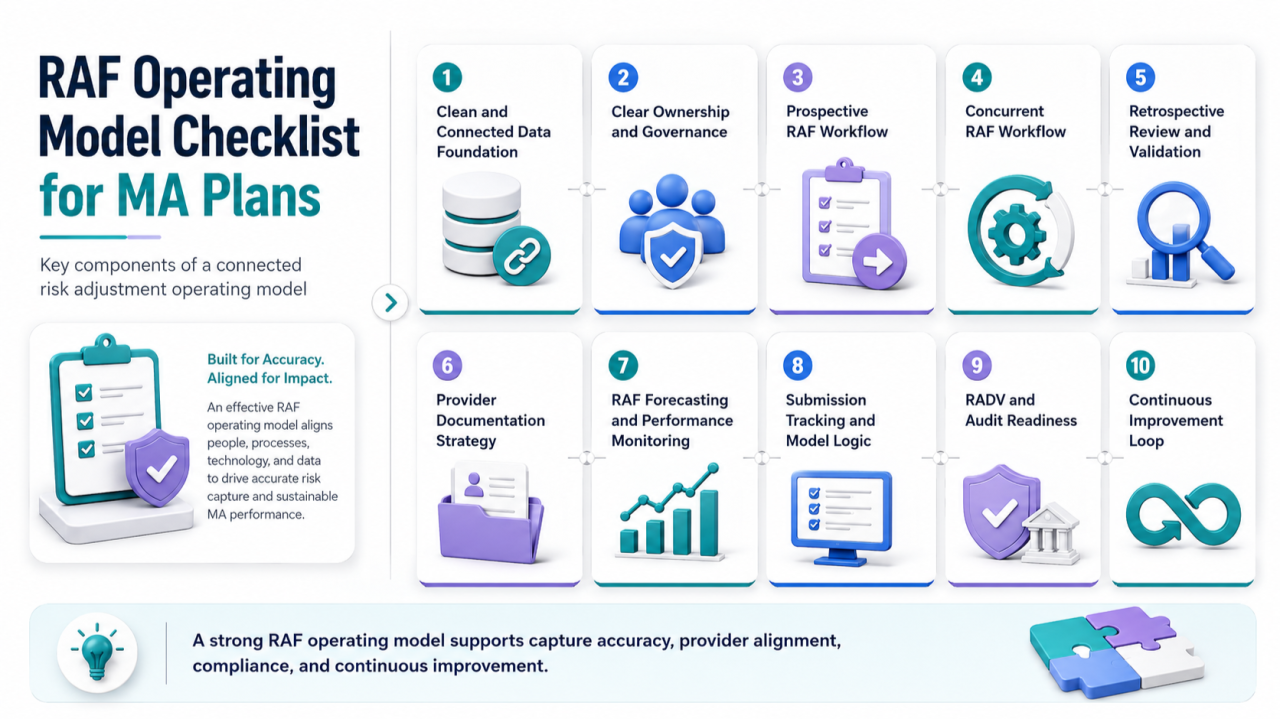
1. Clean and Connected Data Foundation
Every RAF operating model starts with data.
Medicare Advantage plans need a reliable view of claims, encounters, diagnoses, clinical documentation, member history, provider attribution, HCC history, chart review output, and submission status. If these data sources are disconnected, teams spend too much time reconciling information and too little time acting on it.
A strong data foundation should help teams understand:
- 1. Which members had previously captured HCCs
- 2. Which conditions may need recapture this year
- 3. Which suspected conditions require provider review
- 4. Which claims or clinical notes support a diagnosis
- 5. Which provider is connected to the member
- 6. Which submissions are complete, pending, corrected, or missing
When the data foundation is weak, RAF work becomes reactive. Teams discover issues late, depend on manual spreadsheets, and struggle to trust performance reporting.
When the data foundation is strong, the organization can prioritize earlier and move with more confidence.
2. Clear Ownership and Governance
RAF performance touches many departments, so ownership must be clearly defined. Without clear governance, the same question keeps coming back in different forms: Who owns this?
Who owns suspect logic? Who owns provider outreach? Who validates coding rules? Who monitors submission issues? Who decides when documentation is strong enough? Who manages vendor performance? Who explains RAF movement to leadership?
A mature RAF operating model defines ownership across the full lifecycle.
This includes governance for:
- 1. Data definitions
- 2. HCC logic
- 3. Provider attribution
- 4. Documentation standards
- 5. Coding validation
- 6. Workflow ownership
- 7. Vendor oversight
- 8. Compliance review
- 9. Performance reporting
Governance does not need to slow the organization down. Done well, it does the opposite. It gives teams a shared operating language and reduces confusion when decisions need to be made quickly.
3. Prospective RAF Opportunity Identification
The strongest RAF programs do not wait until the end of the year to understand what may have been missed. They identify opportunities earlier.
Prospective RAF workflows help plans use historical diagnoses, claims patterns, utilization, clinical data, and member history to understand where provider attention may be needed before the visit happens.
This does not mean pushing unsupported diagnoses. It means giving providers the right context so they can evaluate the member accurately and document conditions when clinically appropriate.
A strong prospective workflow should help answer:
- • Which members should be prioritized before upcoming visits?
- • Which conditions were documented previously but not yet addressed this year?
- • Which suspected conditions need clinical evaluation?
- • Which provider or care team should receive the information?
- • What evidence supports the opportunity?
Prospective visibility helps RAF teams shift from chasing gaps to preparing action.
4. Provider Documentation Support
RAF accuracy depends heavily on provider documentation.
Coding teams can only code what is supported. If the provider documentation is incomplete, vague, outdated, or missing clinical specificity, the RAF opportunity may not be usable.
This is one of the most common bottlenecks in risk adjustment.
Plans need workflows that make documentation support easier for providers, not more burdensome. Providers should not be asked to hunt through multiple systems, interpret unclear RAF reports, or manually connect patient history to current clinical needs.
A stronger provider documentation model gives providers timely, concise, and clinically relevant information.
That may include:
- • Current-year documentation gaps
- • Previously documented conditions
- • Suspected conditions requiring evaluation
- • Relevant clinical evidence
- • Care gap context
- • Clear prompts inside the provider workflow
- • Feedback loops after coding review
Provider engagement should not feel like a separate administrative campaign. It should feel like useful clinical context delivered at the right time.
5. Concurrent Review Workflows
Retrospective review still matters, but MA plans need stronger concurrent workflows.
Concurrent review helps teams evaluate documentation and coding opportunities closer to the point of care. This gives providers and coding teams a better chance to resolve documentation issues before the window closes.
A strong concurrent RAF workflow should track:
- • Completed encounters
- • Documentation quality
- • HCC capture opportunities
- • Coding review status
- • Missing evidence
- • Provider clarification needs
- • Resolved versus unresolved items
The value of concurrent review is timing.
When review happens too late, teams may identify gaps but have limited ability to correct them. When review happens closer to the encounter, the organization has more room to act, clarify, and improve documentation quality.
6. Retrospective Chart Review Discipline
Retrospective chart review remains part of the RAF operating model, but it should not be the only safety net.
Plans often rely on retrospective review because it is familiar. But if the rest of the operating model is weak, retrospective work can become expensive, manual, and difficult to scale. A disciplined retrospective process should focus on more than volume.
It should help the organization understand:
- • Which opportunities were missed earlier
- • Which providers or groups need documentation support
- • Which conditions create recurring gaps
- • Which vendors are producing useful results
- • Which findings are supported by strong evidence
- • Which issues should be addressed upstream next year
Retrospective review should feed learning back into the operating model.
If the same issues appear every year, the organization does not just have a chart review problem. It has a workflow, documentation, data, or governance problem.
7. Submission Tracking and Encounter Visibility
RAF performance can be affected by what happens after documentation and coding.
Plans need visibility into submission status, encounter acceptance, rejections, corrections, and downstream processing. Without that visibility, teams may believe an opportunity has been captured when it has not been fully submitted or accepted.
A strong RAF operating model tracks the full path from opportunity to submission.
That includes:
- • Identified opportunity
- • Provider documentation
- • Coding validation
- • Submission status
- • Rejection or correction status
- • Final acceptance
- • Reporting impact
This level of visibility helps reduce surprises. It also helps finance, compliance, and operations teams understand where RAF performance is being gained, delayed, or lost.
8. Audit-Ready Evidence and RADV Preparedness
Audit readiness cannot be treated as a year-end activity.
CMS states that during a Medicare Advantage Risk Adjustment Data Validation audit, CMS confirms whether diagnoses submitted by Medicare Advantage organizations are supported in the enrollee’s medical record. If diagnoses are unsupported, CMS may collect overpayments.
That makes evidence management a core part of the RAF operating model. Plans need to know not only which diagnoses were submitted, but also what documentation supports them, where that evidence lives, and whether it can be retrieved and reviewed if needed.
An audit-ready RAF model should include:
- • Clear documentation standards
- • Traceability from diagnosis to source evidence
- • Coding validation rules
- • Provider clarification history
- • Vendor documentation controls
- • Review notes and decision history
- • Reporting that flags unsupported or weakly supported items
The goal is not just to capture RAF opportunity. The goal is to capture the right opportunities with documentation that can be defended.
9. Performance Reporting That Drives Action
Many MA plans have RAF dashboards. Fewer have RAF reporting that truly drives operational action.
A dashboard may show recapture rates, provider performance, open gaps, coding volume, or projected RAF impact. Those views are useful, but they are not enough if teams cannot act from them.
A strong RAF reporting model should connect performance insight to workflow.
For example:
- • If a provider group has low recapture, what action follows?
- • If a condition category is underperforming, who investigates?
- • If documentation quality is weak, how is feedback delivered?
- • If submission rejections increase, who owns resolution?
- • If vendor output changes, how is quality reviewed?
Reporting should not only tell leaders what happened. It should help teams decide what to do next.
10. Continuous Improvement Across the RAF Lifecycle
RAF performance is not fixed by one campaign, one vendor, or one reporting cycle. It improves when the organization treats RAF as a continuously managed operating model.
That means reviewing what worked, what failed, what created friction, and what needs to change before the next cycle.
A continuous improvement model should look at:
- • Provider documentation trends
- • Coding accuracy
- • Suspect logic performance
- • Submission issues
- • Vendor productivity and quality
- • Audit findings
- • Member and provider prioritization
- • Workflow bottlenecks
- • Data quality issues
The best RAF programs do not simply ask, “How did we perform?” They ask, “What did this cycle teach us about the way our operating model needs to improve?”
That mindset is what separates static RAF reporting from scalable RAF execution.
The RAF Operating Model Checklist
MA plans can use the following checklist to evaluate whether their RAF program is ready to scale:
- 1. Do we have clean, connected RAF data across claims, encounters, diagnoses, documentation, providers, and submissions?
- 2. Do we have clear ownership for each part of the RAF lifecycle?
- 3. Can we identify prospective RAF opportunities before provider visits?
- 4. Are providers receiving useful documentation support at the right time?
- 5. Do we have concurrent review workflows that help resolve issues earlier?
- 6. Is retrospective chart review feeding learning back into upstream operations?
- 7. Can we track opportunities from identification through submission and acceptance?
- 8. Do we have audit-ready evidence tied to submitted diagnoses?
- 9. Does our reporting drive action, or does it only summarize performance?
- 10. Do we review and improve the RAF operating model each cycle?
If the answer is “no” to several of these questions, the organization may not have a RAF performance problem alone.
It may have an operating model problem.
From RAF Reporting to RAF Execution
RAF reporting is important. Every MA plan needs visibility into performance. But reporting by itself does not create operational control.
A plan can have dashboards and still struggle with disconnected data, late provider engagement, weak documentation, unclear ownership, manual reconciliation, delayed submissions, and audit exposure.
The next level of RAF maturity is execution readiness. That means having the data, workflows, governance, evidence, and reporting needed to move faster and make better decisions across the full RAF lifecycle.
This is where technology and operating discipline need to work together.
Incuvio RAF Intelligence is designed to help organizations improve visibility across RAF opportunities, HCC trends, model logic, provider performance, and actionable reporting. Incuvio positions the solution around RAF intelligence for V24, V28, and blended models, with a focus on exposing opportunities more quickly and supporting risk adjustment visibility.
Incuvio Warehouse supports the data foundation behind this work by helping healthcare organizations accelerate analytics readiness through connected data models and stronger governance. Incuvio describes its broader approach as transforming healthcare data into opportunities and helping organizations address operational, clinical, and technical hurdles through vendor-independent consulting and technology support.
Together, a stronger data foundation and RAF intelligence layer can help MA plans move beyond static reporting and toward a more connected, auditable, and workflow-aware RAF operating model.
Final Thought
RAF performance is not just about finding more codes. It is about building the operating model that helps teams identify the right opportunities, support the right providers, validate the right evidence, submit accurately, and stay audit-ready.
For Medicare Advantage plans, that distinction matters. The strongest RAF programs are not only report-driven. They are execution-ready.

You may also like
 Articles
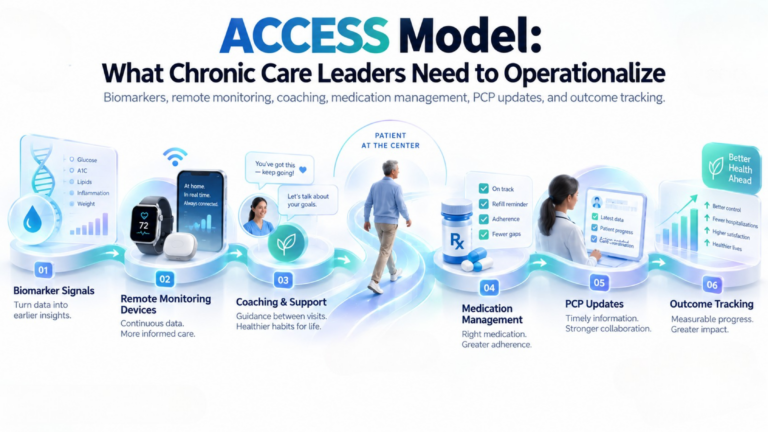
ACCESS Model: What Chronic Care Leaders need to Operationalize
The CMS ACCESS Model has moved from policy concept to operating reality. […]
 Articles
Why Health Plan AI Pilots Fail to Scale
Health plans are investing heavily in AI across predictive analytics, risk adjustment, […]
 Articles
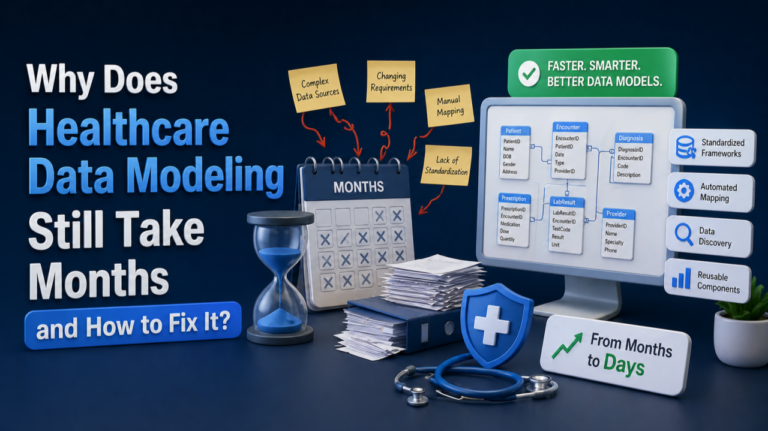
Why Healthcare Data Modeling Takes So Long and How to Fix It
Every healthcare data leader knows the drill. Clinical leadership asks for a […]