Table of Contents
Most Medicare Advantage plans do not suffer from a lack of RAF reports. They have reports everywhere.
Monthly RAF reports. Provider group scorecards. Recapture reports. Suspect condition lists. Chart review output. Submission files. Financial projections. Vendor summaries. Executive dashboards.
The problem is not that plans cannot look backward.
The problem is that too much RAF reporting still explains what already happened, when the real opportunity is to understand what is likely to happen next and what teams should do about it now.
That is where RAF forecasting becomes important.
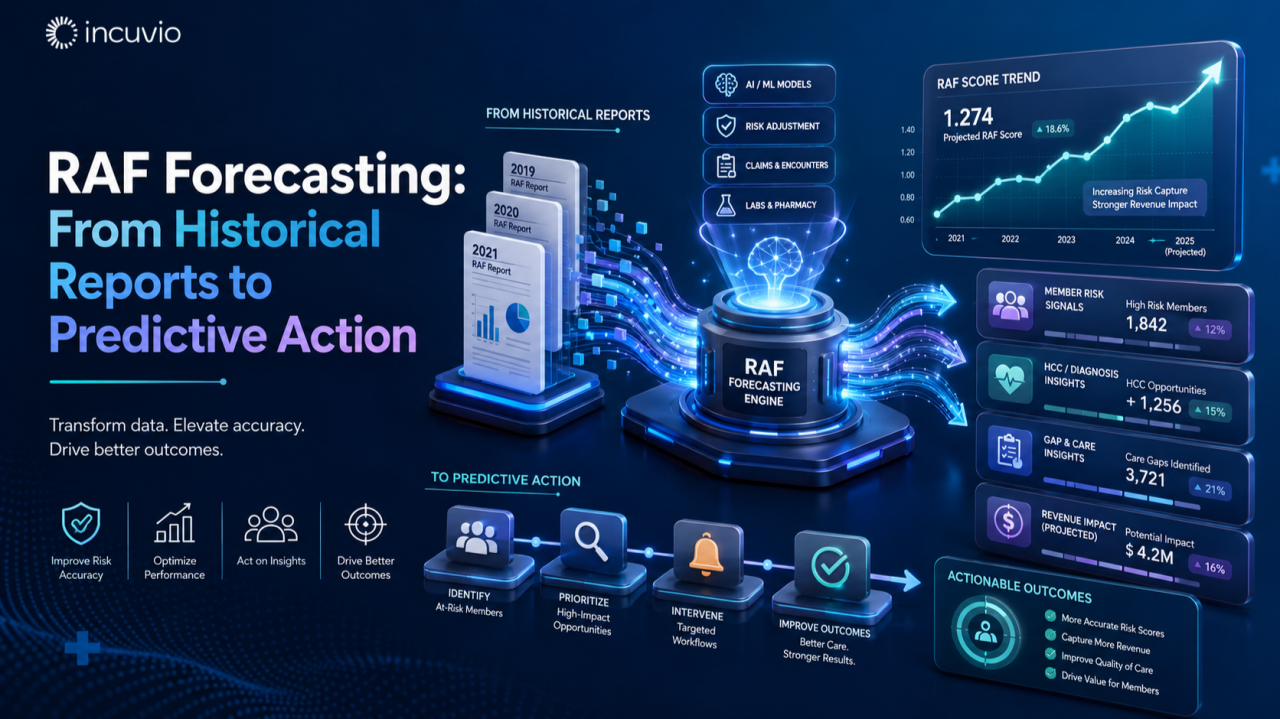
RAF forecasting helps Medicare Advantage organizations move from historical reporting to predictive action. It gives leadership, risk adjustment teams, provider engagement teams, coding teams, finance, and operations a clearer view of where RAF performance is trending before the year is over.
More importantly, it helps teams decide where to focus.
Why Historical RAF Reporting Is No Longer Enough
Historical RAF reporting has value. Plans need to know what was captured, what was missed, how provider groups performed, where documentation gaps appeared, and how actual performance compared to expectations.
But historical reporting has one major limitation. It usually arrives after the opportunity to act has already started to shrink.
By the time a traditional report shows that a provider group is behind on recapture, the plan may already have missed several months of member visits. By the time a dashboard shows open HCC opportunities, some members may not have another scheduled encounter. By the time leadership sees the revenue impact, the operational teams may be working from a backlog.
In RAF operations, timing matters.
A condition that is identified early can be routed into provider workflow, care management, documentation review, and coding validation. A condition that is identified late becomes a chase. And a condition that is never documented appropriately becomes a missed opportunity or a compliance risk.
Risk adjustment is used to estimate the cost of treating a patient in a given year based on that patient’s specific health needs, and a risk score represents predicted cost compared with the average Medicare patient based on characteristics and health conditions. Because of that, RAF accuracy depends on more than analytics. It depends on timely clinical documentation, operational follow-through, and defensible evidence.
That is why MA plans need to ask a different question.
Not just, “What happened?”
But, “What is likely to happen if we do nothing?”
What RAF Forecasting Actually Means
RAF forecasting is the process of using historical data, current-year activity, member risk profiles, provider behavior, open opportunities, documentation status, and submission trends to estimate future RAF performance.
But a strong forecast should not stop at a number.
A useful RAF forecast should help teams understand:
- • Which members had previously captured HCCs
- • Which conditions may need recapture this year
- • Which suspected conditions require provider review
- • Which claims or clinical notes support a diagnosis
- • Which provider is connected to the member
- • Which submissions are complete, pending, corrected, or missing
The goal is not to predict the future perfectly.
The goal is to give teams enough visibility to act earlier, prioritize better, and reduce avoidable surprises.
From Static Reports to Predictive RAF Intelligence
A static report gives you a snapshot. Predictive RAF intelligence gives you direction.
That difference matters because RAF work is not one event. It is a full operating cycle that includes data ingestion, member attribution, opportunity identification, provider engagement, visit preparation, documentation support, coding review, submission tracking, and audit readiness.
When those pieces are disconnected, the forecast becomes unreliable.
For example, a finance team may see expected RAF improvement based on historical capture rates. But if provider visits are down, documentation gaps are high, encounter submissions are delayed, or chart review output is not connected to operational workflow, the forecast may be too optimistic.
A stronger forecasting model looks beyond historical averages.
It brings multiple signals together:
- • Prior-year HCC history
- • Current-year claims and encounters
- • Suspect condition logic
- • Provider attribution
- • Visit schedules and completed encounters
- • Documentation quality
- • Coding review outcomes
- • Submission status
- • Rejection and correction trends
- • Member enrollment and disenrollment
- • Vendor performance
- • Operational backlog
When these signals are connected, plans can see not only where RAF stands today, but where it is likely headed.
The Real Value of RAF Forecasting Is Operational Prioritization
Many organizations think of RAF forecasting as a finance exercise. That is only part of the picture.
Yes, RAF forecasting helps estimate financial impact. But the bigger value is operational prioritization.
A good forecast should help the organization decide where limited time, people, and resources should go.
For example:
- • Which members should be prioritized for provider engagement?
- • Which open conditions should be reviewed before upcoming visits?
- • Which provider groups need documentation support?
- • Which coding queues need attention first?
- • Which submissions are creating risk?
- • Which opportunities should not move forward because evidence is weak?
- • Which interventions are likely to create real impact?
This is where forecasting becomes action.
The forecast should not sit in a leadership deck. It should guide the operating rhythm of the RAF program.
What MA Plans Should Forecast
A strong RAF forecasting model should include several layers. Each layer gives a different view of risk adjustment performance.
1. Recapture Risk
Recapture is one of the most important areas to forecast because previously documented chronic conditions may not automatically carry forward. If a condition remains clinically relevant, it needs to be evaluated and documented appropriately in the current year.
- • Which members have prior-year HCCs not yet captured this year
- • Which conditions are likely to be missed without intervention
- • Which members have upcoming visits where documentation support may help
- • Which provider groups are behind on recapture
- • Which recapture gaps are most material to overall RAF performance
This helps teams move from broad gap lists to targeted action.
2. New Risk Opportunities
Forecasting should also identify where new risk may be emerging.
This may include members with new claims patterns, utilization changes, pharmacy signals, lab indicators, care management notes, or clinical history suggesting the need for evaluation.
The key is to avoid treating suspected opportunities as guaranteed diagnoses.
A strong RAF forecast should distinguish between:
- • Conditions already documented
- • Conditions supported by strong evidence
- • Conditions requiring provider evaluation
- • Conditions with weak or incomplete evidence
- • Conditions that should not be pursued
This protects both operational focus and compliance discipline.
3. Provider Group Performance
RAF performance often varies widely by provider group.
Some groups may document chronic conditions consistently. Others may have lower recapture, delayed encounter submission, weaker documentation specificity, or limited engagement with plan workflows.
Forecasting provider performance helps plans identify where support is needed before year-end.
A useful provider-level forecast should show:
- • Current capture compared with expected performance
- • Open opportunities by provider group
- • Documentation quality trends
- • Visit completion patterns
- • Coding review outcomes
- • Provider response to feedback
- • Potential impact of targeted support
This allows provider engagement teams to have more focused conversations.
Instead of saying, “Your RAF score is behind,” teams can say, “Here are the members, conditions, and documentation opportunities that need attention now.”
4. Submission and Encounter Risk
RAF forecasting should not end with documentation and coding. Plans also need visibility into whether the data is making it through the submission process successfully.
Submission delays, encounter issues, rejections, and corrections can all affect the final picture. A plan may believe it has captured an opportunity, but if that opportunity is not submitted and accepted properly, the expected impact may not materialize.
A strong forecast should include:
- • Submission status
- • Rejection patterns
- • Correction queues
- • Processing delays
- • Encounter completeness
- • Final acceptance visibility
This gives leadership a more realistic view of performance.
5. Documentation Confidence
Not every RAF opportunity carries the same level of confidence.
Some diagnoses may be well supported by current clinical documentation. Others may require clarification, additional provider review, or stronger evidence.
Forecasting should account for documentation confidence, not just opportunity volume. This helps plans avoid inflating forecasts with opportunities that may not be defensible.
A mature RAF forecasting model should separate:
- • High-confidence documented opportunities
- • Opportunities pending coding review
- • Opportunities needing provider clarification
- • Suspect conditions needing evaluation
- • Low-confidence items that should be excluded or deprioritized
This is especially important as compliance expectations and audit scrutiny continue to increase.
Why RAF Forecasting Requires a Strong Data Foundation
Predictive action depends on trusted data.
If claims, encounters, eligibility, provider attribution, coding outputs, chart review findings, and submission files sit in separate systems, forecasting becomes slow and inconsistent.
Teams end up reconciling spreadsheets instead of acting on the forecast.
A strong RAF forecasting foundation needs:
- • Clean member identity resolution
- • Connected claims and encounter data
- • Current provider attribution
- • Historical and current-year diagnosis history
- • Standardized HCC logic
- • Documentation and chart review visibility
- • Submission tracking
- • Governance around definitions and assumptions
- • Clear refresh schedules
- • Traceability from forecast to source data
Without this foundation, the forecast may look precise but still be unreliable.
Healthcare leaders should be cautious of forecasts that produce a number without showing the assumptions behind it. A good forecast should be explainable. Teams should be able to understand where the projection came from, what data was used, what assumptions were applied, and which actions could change the outcome.
Turning RAF Forecasting Into Action
The most important part of RAF forecasting is what happens after the forecast is produced. A forecast only creates value when it changes decisions.
Here is how MA plans can turn RAF forecasting into operational action.
1. Prioritize Members Earlier
Forecasting helps teams identify which members need attention before the opportunity window narrows.
Instead of working from a large, undifferentiated list, teams can prioritize members based on expected impact, upcoming visits, documentation status, care needs, and provider relationship.
This makes outreach and provider workflow support more focused.
2. Support Providers With Better Context
Providers do not need more administrative noise. They need useful clinical context.
RAF forecasting can help provider engagement teams prepare more relevant documentation support. That may include prior conditions, open care gaps, suspected conditions requiring evaluation, and evidence that helps the provider make an informed clinical decision.
The goal is not to push codes. The goal is to help providers document the full clinical picture accurately and appropriately.
3. Improve Concurrent Review
Forecasting should also guide concurrent review.
If teams can see which encounters are most likely to affect RAF performance, coding and documentation review can happen closer to the point of care. This gives teams more time to clarify, correct, and resolve documentation issues.
Concurrent review is more effective when it is guided by predictive prioritization rather than simple queue order.
4. Give Leadership Better Visibility
Executives need more than a final RAF number. They need to know what is driving the forecast.
A strong RAF forecast should help leadership understand:
- • What portion of projected RAF is already supported
- • What portion depends on future provider action
- • What portion is still at risk
- • Which operational bottlenecks could affect performance
- • Which provider groups or regions need support
- • Which assumptions could change the forecast
This creates a more honest and useful executive conversation.
5. Strengthen Audit Readiness
Forecasting can also support audit readiness by identifying weak points earlier. If a forecast includes opportunities that lack strong documentation, those items should be flagged before they become submission or audit risk.
Plans need to know not only what they expect to capture, but how well supported those opportunities are. That connection between forecasting and evidence is critical.
Common Mistakes in RAF Forecasting
RAF forecasting can create major value, but only when it is designed carefully.
Here are common mistakes MA plans should avoid.
1. Treating Forecasting as Only a Finance Model
Finance needs RAF projections, but RAF forecasting cannot live only in finance.
If the forecast does not connect to provider action, coding operations, submission status, and documentation quality, it becomes disconnected from the work that actually changes outcomes.
2. Over-Relying on Historical Averages
Historical data is useful, but the future year may not behave like the prior year.
Membership changes. Provider behavior changes. Utilization changes. Coding rules change. Operational capacity changes. Vendor performance changes. Documentation quality changes.
A forecast that relies too heavily on last year’s pattern may miss what is changing now.
3. Ignoring Workflow Bottlenecks
A forecast may show opportunity, but if teams do not have the workflow capacity to act, the opportunity may never convert.
Plans should forecast not only potential RAF impact, but also operational feasibility.
4. Counting Weak Opportunities Too Early
Not every suspected condition should be treated as expected RAF impact.
Forecasting models should separate likely, pending, uncertain, and low-confidence opportunities. This protects the organization from overestimating performance.
5. Reporting Without Action Ownership
A forecast should make ownership clear.
If a provider group is behind, who follows up? If documentation is weak, who reviews it? If submissions are delayed, who resolves them? If the forecast changes, who explains why?
Without ownership, forecasting becomes another report.
What a Mature RAF Forecasting Operating Model Looks Like
A mature RAF forecasting operating model is not just a dashboard. It is a connected process.
It brings together data, analytics, operations, provider engagement, coding, submissions, compliance, and leadership decision-making.
A mature model usually includes:
- • A trusted RAF data foundation
- • Clear forecasting assumptions
- • Member-level and provider-level visibility
- • Opportunity confidence scoring
- • Documentation and evidence tracking
- • Submission and encounter monitoring
- • Scenario modeling
- • Regular operating reviews
- • Clear action ownership
- • Feedback loops that improve the model over time
This is how MA plans move from explaining performance to managing performance.
Key Questions Leaders Should Ask
Healthcare leaders do not need to become data scientists to evaluate RAF forecasting maturity. But they should ask better operating questions.
For example:
- • Are we forecasting RAF performance early enough to act?
- • Can we see which opportunities are already documented versus still uncertain?
- • Do our provider teams know which members and conditions to prioritize?
- • Can finance, operations, coding, and compliance see the same version of the truth?
- • Are we connecting forecasts to actual workflows?
- • Do we know which assumptions are driving the projection?
- • Can we explain changes in the forecast month over month?
- • Are we tracking submission risk as part of the forecast?
- • Are weakly supported opportunities clearly separated from strong ones?
- • Does our forecast help teams make better decisions, or does it simply update leadership?
These questions help move the conversation from analytics to execution.
How Incuvio Helps MA Plans Move Toward Predictive RAF Action
RAF forecasting requires more than a reporting layer. It requires a connected healthcare data foundation, clear model logic, operational visibility, and workflows that help teams act on the forecast.
Incuvio’s broader approach is focused on transforming healthcare data into opportunities and helping organizations address operational, clinical, and technical hurdles through vendor-independent consulting and technology support.
Incuvio RAF Intelligence is designed to expose RAF opportunities more quickly, apply advanced analytics, identify patterns and trends, and support actionable reporting for RAF improvement.
For MA plans, that means RAF forecasting can become more than a monthly report. It can become an operating tool.
A stronger RAF intelligence layer helps organizations:
- • Understand where RAF performance is trending
- • Identify opportunities earlier
- • Prioritize provider and member action
- • Improve visibility across the RAF lifecycle
- • Support documentation and coding workflows
- • Strengthen executive reporting
- • Reduce manual reconciliation
- • Build a more predictive operating model
The future of RAF performance will not be won by teams that only report faster. It will be won by teams that act earlier.
Final Thought
Historical RAF reporting tells a plan what already happened.
RAF forecasting tells a plan what may happen next. But predictive action is where the real value lives.
For Medicare Advantage organizations, the goal is not simply to create a better forecast. The goal is to build a RAF operating model that helps teams make better decisions earlier, support providers more effectively, improve documentation quality, and reduce avoidable performance surprises.

You may also like
 Articles
ACCESS Model: What Chronic Care Leaders need to Operationalize
The CMS ACCESS Model has moved from policy concept to operating reality. […]
 Articles
Why Health Plan AI Pilots Fail to Scale
Health plans are investing heavily in AI across predictive analytics, risk adjustment, […]
 Articles
Why Healthcare Data Modeling Takes So Long and How to Fix It
Every healthcare data leader knows the drill. Clinical leadership asks for a […]