Table of Contents
Healthcare organizations are being asked to make bigger technology decisions faster.
Modernize the data environment. Evaluate AI. Replace legacy systems. Improve interoperability. Strengthen cybersecurity. Support value-based care. Integrate new acquisitions. Build better clinical and operational workflows.
Each initiative may look like a technology project.
In reality, most are business transformation decisions with technology at the center.
That creates a challenge for healthcare organizations that need experienced technology leadership but may not yet need—or be ready to hire – a full-time Chief Technology Officer.
A fractional CTO can fill that gap.
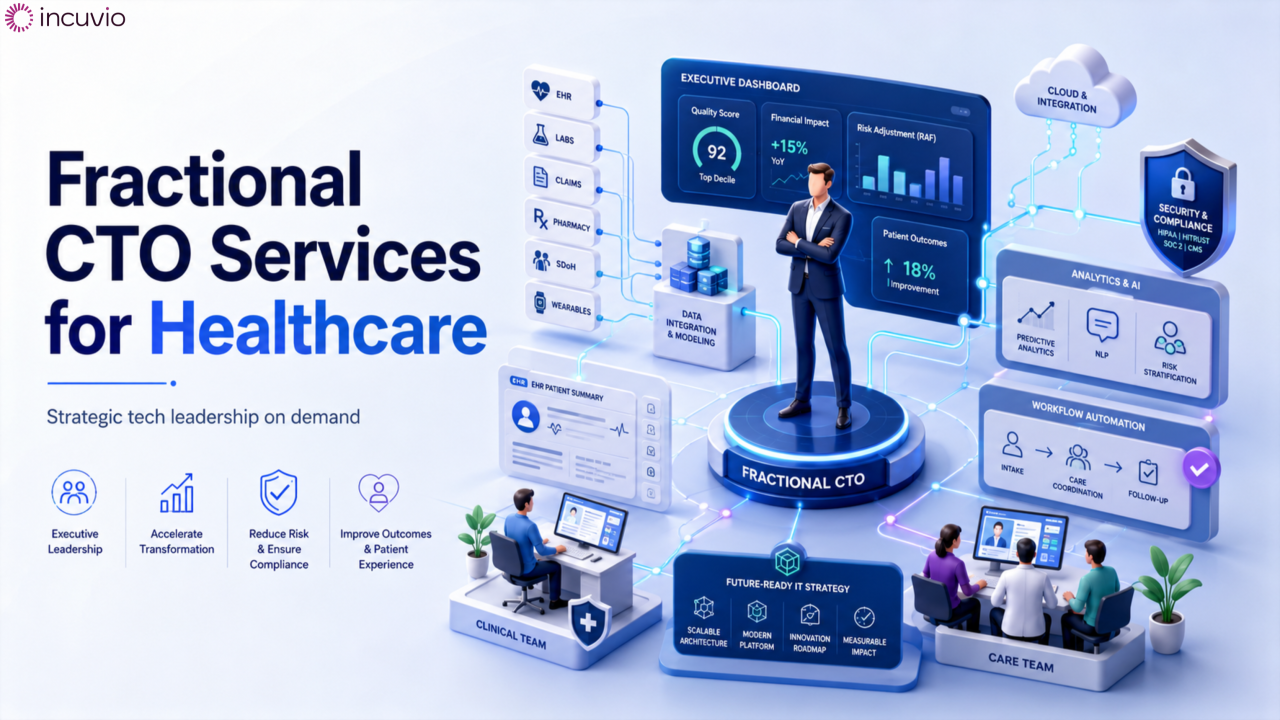
The role provides senior technology leadership when and where it is needed, helping healthcare organizations connect business priorities with architecture, systems, data, vendors, and execution.
What is a Fractional CTO?
A fractional CTO is an experienced technology executive who works with an organization on a part-time, interim, project, or advisory basis.
The role is not simply outsourced IT management.
A strong fractional CTO operates at the strategic level, helping leadership answer questions such as:
- • Which technology investments should we prioritize?
- • Which legacy systems are creating unnecessary cost or risk?
- • Should we buy, build, integrate, or replace?
- • Is our data architecture ready for growth?
- • How should we evaluate AI opportunities?
- • Are our vendors aligned with our long-term strategy?
- • Can our technology environment support the next stage of the business?
For healthcare organizations, those decisions require more than general technology experience.
They require an understanding of healthcare data, clinical and operational workflows, interoperability, regulatory requirements, and the realities of implementing technology across complex organizations.
Why Healthcare Technology Leadership Is Different
Healthcare technology sits at the intersection of clinical care, operations, compliance, finance, and data.
A decision that appears simple from an IT perspective can have consequences across the organization.
Replacing an EHR interface can affect clinical workflows.
Changing the data architecture can affect RAF, quality, provider reporting, and financial analytics.
Introducing an AI solution can create new questions around data quality, governance, privacy, workflow integration, and adoption.
A healthcare technology strategy therefore cannot be developed in isolation.
It needs to connect the technology roadmap with the organization’s actual operating model.
That is one of the biggest advantages of bringing in experienced healthcare technology leadership earlier.
1. Technology Strategy Becomes a Business Strategy
Many organizations have a technology roadmap.
Fewer have a technology roadmap that clearly supports business priorities.
Projects often accumulate over time:
- • A new analytics platform.
- • Another point solution.
- • A custom application.
- • A cloud migration.
- • A provider portal.
- • An AI pilot.
Individually, each initiative may have a reasonable business case. Together, they can create an expensive and fragmented technology environment.
A fractional CTO can step back from individual projects and look at the full picture.
The role should help leadership determine:
- • What the organization needs now
- • What can wait
- • What should be consolidated
- • Where technical debt is creating friction
- • Which investments will support future scale
- • Which initiatives do not justify the cost
The objective is not to deploy more technology.
It is to make better technology decisions.
2. Organizations Gain Vendor-Independent Guidance
Healthcare organizations rely on a growing number of technology vendors.
Every vendor has a compelling roadmap.
Every platform promises integration.
Every new solution seems capable of solving several problems at once.
Someone still needs to evaluate those claims against the organization’s architecture and business requirements.
A fractional CTO can provide a more independent view of:
- • Vendor fit
- • System capabilities
- • Integration requirements
- • Total cost of ownership
- • Implementation complexity
- • Scalability
- • Build-versus-buy decisions
- • Long-term architectural impact
That independence matters.
The best solution is not necessarily the platform with the longest feature list. It is the one that fits the organization’s requirements without creating unnecessary complexity somewhere else.
3. Data Modernization Gets Executive Ownership
Healthcare organizations increasingly depend on data for almost every major initiative.
- • Risk adjustment.
- • Quality performance.
- • Population health.
- • Provider performance.
- • Financial forecasting.
- • Care management.
- • AI and predictive analytics.
But data modernization projects can easily become technical programs without clear executive ownership.
Teams begin discussing warehouses, pipelines, APIs, schemas, cloud platforms, and interoperability standards while the original business outcome becomes less visible.
A fractional CTO can keep the data strategy connected to the decisions the organization needs to make.
For example: Instead of asking only, “How do we centralize our data?”
The better questions may be:
- • How quickly can we identify provider performance issues?
- • Can teams see the same member across claims and clinical systems?
- • Can leadership understand contract performance without manual reconciliation?
- • Is our data reliable enough to support AI?
- • Can operational teams act on insights, or are we only building dashboards?
Technology architecture matters.
But the architecture should always support an operational outcome.
4. Strategy Gets Closer to Execution
One of the most common problems in digital transformation is the gap between the strategy deck and the implementation.
Leadership approves the direction.
The project starts.
Then requirements change, vendors disagree, internal teams interpret priorities differently, and business stakeholders become disconnected from the technical work.
Months later, the project may still be moving—but not necessarily toward the original objective.
A fractional CTO can help bridge that gap.
The role can provide executive oversight while working closely enough with technical and operational teams to identify problems early.
That may involve:
- • Validating architecture decisions
- • Reviewing implementation plans
- • Resolving technical trade-offs
- • Aligning vendors
- • Prioritizing requirements
- • Removing unnecessary scope
- • Helping executives understand technical risks
- • Keeping delivery connected to the business case
Healthcare transformation rarely fails because an organization lacked ideas.
Execution is usually the harder part.
5. Leadership Can Scale With the Organization
Not every healthcare organization needs the same level of technology leadership at every stage.
A health tech startup preparing for its next growth phase has different needs from an MSO integrating multiple provider groups.
A healthcare organization replacing legacy infrastructure has different needs from one evaluating an AI strategy.
And an organization going through an acquisition may temporarily need far more technology leadership than it will require once integration is complete.
A fractional model allows the leadership capacity to match the situation.
Organizations can bring in senior expertise for a specific transformation, stabilization effort, architecture review, or growth period without automatically creating a permanent executive position.
This can be especially useful when the immediate need is strategic clarity and execution support rather than another layer of management.
When Does a Fractional CTO Make Sense?
The model can be useful when an organization is experiencing situations such as:
- • Rapid growth is putting pressure on existing systems
- • Technology spending is increasing without clear ROI
- • Multiple vendors are creating a fragmented environment
- • Leadership is planning a major platform or cloud migration
- • Data modernization has stalled
- • The organization is preparing for AI adoption
- • Legacy systems are limiting operational growth
- • A merger or acquisition requires technology integration
- • Product development needs stronger technical leadership
- • Major initiatives lack clear technical ownership
Another sign is simpler:
Technology decisions are regularly reaching the executive team, but no one at the table owns the complete technology strategy.
That gap tends to become more expensive as an organization grows.
What Should a Fractional CTO Actually Deliver?
A fractional CTO engagement should produce more than advice.
Leadership should expect tangible outputs.
Depending on the organization’s needs, that may include:
Technology Assessment
A clear understanding of the current technology environment, technical debt, architecture gaps, risks, and immediate priorities.
Technology Roadmap
A prioritized plan connecting technology investments with business objectives, timelines, dependencies, and expected outcomes.
Architecture Direction
Recommendations for data architecture, applications, integrations, cloud infrastructure, interoperability, and future scalability.
Vendor Strategy
A structured approach to evaluating existing vendors, selecting new solutions, and determining where consolidation may make sense.
Execution Governance
Clear decision-making structures, ownership, technical standards, and oversight for major initiatives.
Leadership Alignment
A common understanding across business, clinical, operational, and technology teams of what is being built and why.
If an engagement produces only recommendations without helping the organization move toward execution, much of the value is lost.
Fractional CTO vs. Full-Time CTO
This is not necessarily an either-or decision.
For some organizations, hiring a permanent CTO is absolutely the right move.
The question is timing.
A full-time CTO makes sense when technology leadership is a continuous executive requirement and the organization needs someone permanently embedded in leadership, culture, hiring, product development, and operations.
A fractional CTO can make more sense when:
- • The strategic need is immediate
- • The organization is still defining the long-term role
- • A major transformation needs experienced oversight
- • The company is between technology leaders
- • Senior expertise is needed without a permanent executive hire
- • Leadership wants an independent assessment before making larger investments
In some cases, fractional leadership can also help define what the organization should eventually look for in a permanent CTO.
How Incuvio Approaches Fractional CTO Services
Incuvio provides fractional CTO services specifically for healthcare organizations, including growing healthcare companies and organizations navigating digital transformation.
The approach combines technology leadership with experience across healthcare data, enterprise architecture, system modernization, workflow improvement, and technology strategy.
Rather than approaching technology as an isolated IT function, Incuvio focuses on connecting technical decisions with operational and business outcomes.
That can include helping organizations:
- • Assess their current technology environment
- • Define a scalable technology roadmap
- • Modernize enterprise architecture
- • Evaluate vendors and platforms
- • Strengthen healthcare data strategy
- • Guide system implementation
- • Improve technical governance
- • Align technology teams with business priorities
The objective is straightforward:
Help organizations make better technology decisions and turn those decisions into execution.
Final Thought
Healthcare organizations do not always need more technology.
They often need greater clarity about the technology they already have, what they should build next, and which investments will actually move the business forward.
That requires leadership.
For organizations that need senior technology direction without immediately adding a permanent executive role, a fractional CTO can provide a practical middle ground.
Experienced enough to operate at the executive level.
Close enough to the work to understand what is actually happening.
And flexible enough to focus leadership where the organization needs it most.

You may also like
 Articles
ACCESS Model: What Chronic Care Leaders need to Operationalize
The CMS ACCESS Model has moved from policy concept to operating reality. […]
 Articles
Why Health Plan AI Pilots Fail to Scale
Health plans are investing heavily in AI across predictive analytics, risk adjustment, […]
 Articles
Why Healthcare Data Modeling Takes So Long and How to Fix It
Every healthcare data leader knows the drill. Clinical leadership asks for a […]