Table of Contents
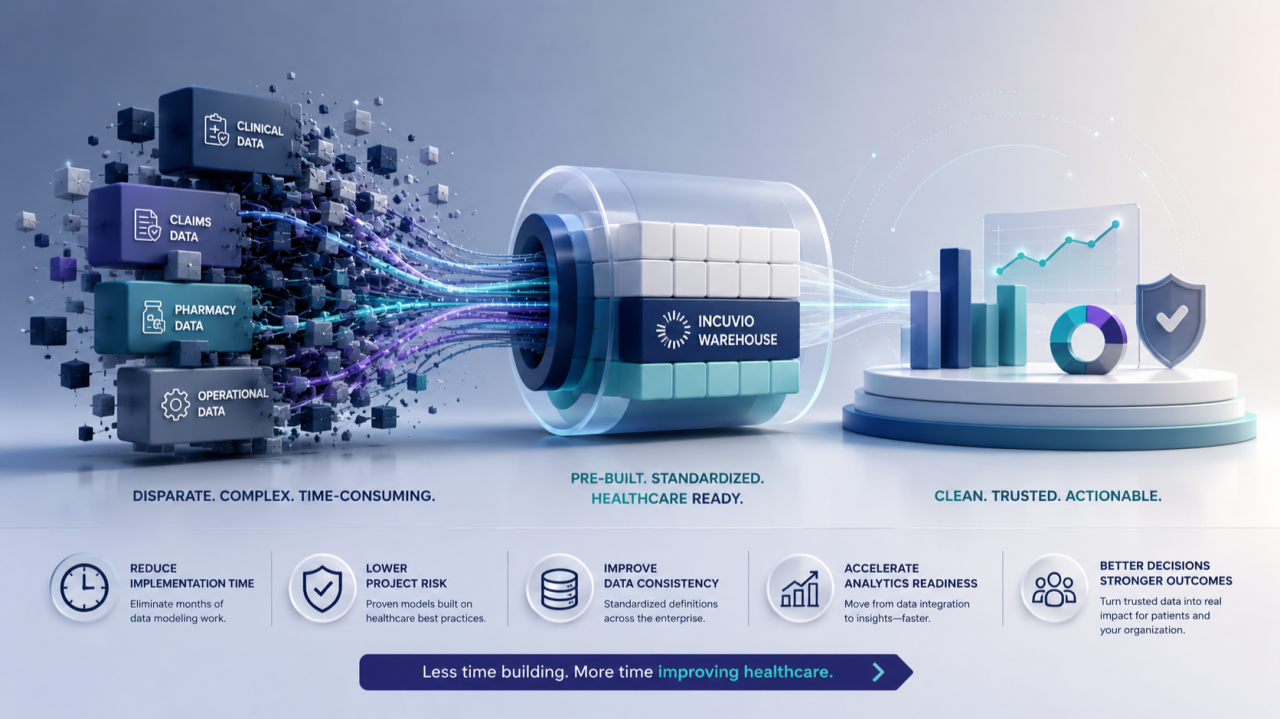
Healthcare data warehouse projects often begin with a straightforward goal: bring data together so teams can report, analyze, and act on it.
Then the modeling work starts.
Claims have to be structured. Clinical data has to be normalized. Pharmacy data follows different conventions. Member and provider identities have to be connected. Eligibility changes over time. Risk adjustment introduces another set of relationships and business rules.
Before the first useful dashboard is delivered, teams can spend a significant amount of time simply deciding how the data should be organized.
That is why pre-built healthcare data models matter.
They give organizations a healthcare-aware starting point instead of forcing every warehouse project to begin with a blank schema.
Why Data Modeling Becomes a Healthcare Warehouse Bottleneck
The technology used to store data is only one part of a healthcare data warehouse.
The harder question is often:
What should the data look like once it gets there?
Teams need to define how members relate to coverage periods, providers, encounters, diagnoses, procedures, prescriptions, clinical observations, care gaps, and risk adjustment activity.
Those decisions affect almost everything built afterward.
If eligibility history is modeled incorrectly, population reporting can be wrong. If claims and encounters are treated as the same thing, utilization may be overstated. If provider relationships are not historically dated, attribution reporting can become unreliable.
And when each new data source requires another round of architecture meetings, schema design, validation, and rework, the implementation timeline grows quickly.
A data warehouse can therefore be technically available long before it becomes analytically useful.
What is a Pre-Built Healthcare Data Model?
A pre-built healthcare data model provides an established structure for common healthcare data domains.
Instead of asking a project team to determine every table, relationship, naming convention, and business concept from the beginning, organizations start with structures already designed around healthcare information.
Depending on the use case, those structures may cover:
- • Member and eligibility data
- • Provider information
- • Medical claims
- • Prescription claims
- • Clinical data
- • Diagnoses and procedures
- • Risk adjustment
- • Utilization
- • Quality and operational data
The organization’s own source systems still need to be mapped into the model.
That work does not disappear.
What changes is that teams are no longer spending the first phase of the project designing the entire destination before mapping can begin.
Why Pre-Built Models Can Shorten Time to Analytics
The biggest advantage is not simply faster database development.
It is faster time to useful data.
Start Data Mapping Earlier
In a traditional implementation, source-to-target mapping may have to wait until the target model has been sufficiently defined.
With a pre-built structure, teams already know where common healthcare information is expected to go.
They can begin asking practical questions earlier:
- • Which source contains member eligibility?
- • Which field represents the rendering provider?
- • How do our claim statuses map into the target structure?
- • Where is prescription activity coming from?
- • Which identifiers can connect clinical and claims data?
The project moves from architecture discussion to implementation sooner.
Reduce Repetitive Design Work
Claims, eligibility, providers, diagnoses, medications, and clinical encounters are not unique concepts to one healthcare organization.
Yet teams frequently rebuild structures for these domains from scratch during every warehouse initiative.
A pre-built healthcare data model lets teams reuse established patterns for the common parts of the data environment and spend more time on what is actually unique: local systems, contracts, business rules, workflows, and reporting requirements.
Create More Consistency
When different teams build their own versions of the same healthcare concepts, definitions begin to drift.
One report may calculate membership differently from another. Provider attribution may be represented differently across analytics applications. Claims logic may change depending on which analyst built the dataset.
A standardized model helps create a common foundation.
It does not automatically solve governance, but it makes governance easier because teams have a consistent structure around which definitions and rules can be established.
Why Healthcare Benefits More Than Most Industries
Pre-built modeling is valuable in many industries, but healthcare has an unusually high level of data complexity.
A single member journey may involve:
- • Enrollment records from a health plan
- • Claims from multiple providers
- • Clinical information from different EHRs
- • Pharmacy transactions
- • Laboratory results
- • Care management activity
- • Quality measures
- • Risk adjustment documentation
- • Provider attribution
- • Financial performance
These records were not necessarily created to work together.
Yet healthcare organizations increasingly need a longitudinal view that connects them.
That is why healthcare-specific modeling matters. A generic warehouse structure may store the information, but it may not represent the relationships required for healthcare analytics and operations without significant additional design.
Pre-Built Does Not Mean One-Size-Fits-All
This distinction matters.
A pre-built healthcare data model should accelerate the foundation—not force every organization into exactly the same implementation.
Every healthcare organization still has differences in:
- • Source systems
- • Data quality
- • Provider relationships
- • Contract structures
- • Business definitions
- • Reporting requirements
- • Operational workflows
The pre-built model provides the starting architecture.
Teams then extend or configure that foundation around the organization’s requirements.
Think of it less as buying a finished house and more as starting with a strong healthcare-specific blueprint instead of designing every structural component from an empty page.
The Bigger Benefit: Getting Technical Teams Closer to Business Value
Long data warehouse projects create another problem that is easy to overlook.
Business priorities keep moving while the infrastructure is being built.
Leadership may need better provider performance reporting. Risk adjustment teams may need member-level visibility. Operations may need faster utilization data. Finance may need contract performance analytics.
If foundational data modeling consumes months of the project, those teams continue working with disconnected spreadsheets and existing reporting processes.
Shortening the modeling phase helps technical teams get closer to business value sooner.
Instead of spending most of the early project asking how to represent healthcare data, they can begin asking:
What decisions should this data help us make?
That is a much more valuable conversation.
When Should Healthcare Organizations Consider Pre-Built Models?
A pre-built healthcare data model can be especially valuable when an organization is:
- • Building a new enterprise data warehouse
- • Replacing a legacy healthcare warehouse
- • Migrating to a modern cloud data platform
- • Integrating multiple payer or provider data sources
- • Preparing data for advanced analytics or AI
- • Consolidating reporting after an acquisition or expansion
- • Developing value-based care analytics
- • Building a foundation for risk adjustment and population health use cases
The more standard healthcare domains involved in the initiative, the less sense it makes to redesign every foundational structure from scratch.
How Incuvio Warehouse Approaches the Problem
Incuvio Warehouse was designed around this exact bottleneck.
It provides standardized healthcare data models across clinical subject areas, medical claims, prescription claims, and Medicare risk adjustment data. The models are designed to work with platforms including Microsoft SQL Server, Snowflake, and Amazon Redshift.
Instead of beginning with a blank schema, healthcare organizations can use an established foundation and begin source-to-target mapping earlier.
That can help teams:
- • Reduce repetitive data modeling work
- • Accelerate warehouse implementation
- • Improve consistency across healthcare data domains
- • Move toward analytics readiness sooner
- • Create a stronger foundation for future reporting and operational use cases
Incuvio describes the goal of Warehouse as delivering value faster by reducing the time-intensive data modeling stage that often delays healthcare warehousing initiatives.
The point is not to eliminate thoughtful data architecture.
It is to stop spending valuable project time rebuilding structures that healthcare organizations need again and again.
From Data Warehouse to Decision-Ready Data
A healthcare data warehouse should not be judged only by how much data it stores.
Its value comes from how quickly that information becomes trusted and usable.
Pre-built healthcare data models help shorten one of the slowest parts of that journey by giving organizations a structured starting point for common healthcare domains.
Teams still need strong mapping, governance, validation, and business alignment.
But they do not necessarily need to start from zero.
For healthcare organizations trying to modernize their data environment, that distinction can mean spending less time designing foundational structures and more time using data to improve decisions.
Ready to accelerate your healthcare data warehouse initiative?
Explore Incuvio Warehouse to see how pre-built healthcare data models can help your organization move from source data to analytics readiness faster.

You may also like
 Articles
ACCESS Model: What Chronic Care Leaders need to Operationalize
The CMS ACCESS Model has moved from policy concept to operating reality. […]
 Articles
Why Health Plan AI Pilots Fail to Scale
Health plans are investing heavily in AI across predictive analytics, risk adjustment, […]
 Articles
Why Healthcare Data Modeling Takes So Long and How to Fix It
Every healthcare data leader knows the drill. Clinical leadership asks for a […]